
The Future of Life Insurance Agents in the Era of Evolving AI with Growing Insightfulness, Professionalism and Empathy
Roy Wang, Head of Agency Digitalization & Innovation, AIA Life Insurance
Introduction
Evolving Insurance literacy and Restructuring of Life Insurance Distribution
Life insurance products have been regarded as financial services that require proactive marketing to stimulate customers' insurance demands for a long time owing to deferred benefit realization. Meanwhile, given high product complexity and long contractual cycle, professional advisors remain indispensable for policy interpretation and consumer engagement. However, with the continuous growth of insurance penetration and density, public insurance literacy will also improve correspondingly. People are more likely to make insurance purchases voluntarily, which reduces their reliance on traditional sales agents. Meanwhile, rising insurance awareness is also accompanied by higher expectations for service quality, leading to stricter professional requirements for insurance practitioners.
Taking mainland China as an example, life insurance agent headcount peaked at 9.1 million in 2019 and declined to 2.6 million by the end of 2024 [1], with the COVID19 pandemic acting as an accelerator for this shrinkage. In contrast, new business premium remained relatively stable over the same period.
Figure 1: China ‘s New Policy Premium and Life Insurance Agent Scale, 2019-2024
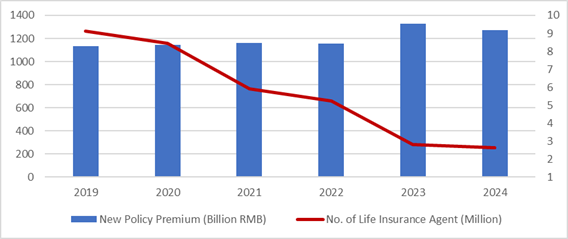
Source: China Insurance Yearbook from 2019–2024
This phenomenon well confirms the changes in the market situation: as public insurance awareness improves, consumer reliance on traditional agents declines. This trajectory is highly consistent with historical precedents in mature markets. By the late 1980s, the headcount of life insurance agents in Japan exceeded 3 million. Over the following three decades, it suffered a continuous downward trend, and the total amount dropped below 400 thousand after 2010, representing a decline of more than 80% [2]. A similar trend can also be observed in the US market.Between 1985 and 2010 the number of life insurance agents declined nearly 40% from 275 thousand to 175 thousand [3].
In the meantime, driven by enhanced public insurance awareness and advances in internet technologies, online insurance distribution has entered a phase of rapid development in Mainland China. According to the Insurance Association of China (IAC), the total premium of online insurance reached 494.9 billion (RMB) in 2023, more than triple of the figure in 2018[4].
Nevertheless, observations reveal that online insurance products are mostly short‑term ones with simple coverage benefits. Complex insurance products remain heavily relying on traditional offline distribution, as consumers can hardly understand the intricate terms of sophisticated policies merely through online browsing.
AI Empowerment: A Prospective Breakthrough for Online Insurance Distribution
Despite the current limitation of online insurance channels, advances in AI technology create new opportunities for online distribution. It enables needs analysis through continuously enriched customer profiles constructed by online footprints, which facilitates precise product recommendations. It can also interpret intricate insurance terms, thereby breaking down barriers to selling complex products online. Collectively, these capabilities mitigate the informational asymmetry, a constraint that has long confined sales of complex policies to traditional agents; therefore, making scalable online distribution practically feasible.
Purpose of Paper
The purpose of this paper is to explore and evaluate the likelihood that AI, particularly Generative AI and its subsequent evolution, Agentic AI1 , may replace traditional life insurance agents. The research is mainly focused on mainland China, with supplementary data and case evidence drawn from other global insurance markets for reference. Relevant arguments will be structured around three core dimensions: consumer purchasing behaviors, cost control for life insurers and technological progress. In addition, potential risks arising from AI displacement of human agents will also be discussed comprehensively.
_______________________________________________________________________________________________________
1Gen AI creates content reactively based on explicit human prompts while Agentic AI can autonomously complete multi-step tasks after initial goal setting
_______________________________________________________________________________________________________
Shifting Consumer Purchasing Behaviors
Income Growth and Voluntary Insurance Consumption
As per capita income increases, risk perceptions and insurance consumption patterns of residents would also change. With the improvement of living standards, household risk awareness will gradually strengthen which convert potential demand for life insurance into active purchasing behavior and finally make a structural transformation from passive purchases to self‑driven decisions.
Recent research in the US proves that individuals with higher incomes tend to purchase life insurance more proactively [5]. The evidence in mainland China can also support this point. Life insurance density exhibits a strong positive correlation with GDP per capita as shown in figure 2 below. On the other hand, as mentioned earlier, internet insurance has experienced rapid growth during the same period. In addition, insurance consumer survey of 2025 indicates that online channel has become the primary insurance purchasing choice for consumers for the first time [6], which corroborates a fundamental shift from passive purchasing to proactive choice driven by higher income.
Figure 2: China‘s GDP per Capita and Insurance Density, 2016–2025
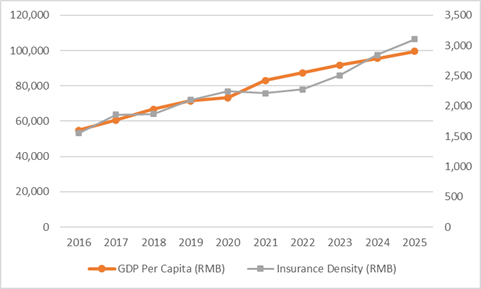
Source: National Bureau of Statistics of China. Data cover the period 2016–2025.
Digital Natives and Online‑oriented Insurance Adoption
Apart from economic drivers, generational difference is another core factor in reshaping the consumption patterns of life insurance. Digital natives, especially Gen Z, display a clear preference for self-guided insurance services. Many of these young consumers are also concerned that agents may prioritize their own financial interests over customer needs. According to a survey by Agentero in 2022, only 43% of 1,000 Gen Z have worked with an insurance agent for policy purchases [7]. They are more inclined to research and compare different plans independently and complete transactions via online platforms. This pattern is also prominent in mainland China, where younger generations raised on mobile internet have become the core demographic driving online insurance growth. According to China Internet Insurance Consumer Insight Report in 2024, the online insurance purchase rate among post-1995 generations has reached 84% [8].
Another critical element lies in the shift of trust. Research indicates that the Fourth Industrial Revolution is gradually shifting trust from interpersonal relationships toward “system trust” which is the trust in a system based on digital technology [9]. For younger generations, trust is highly related to platform credibility, algorithmic transparency and unbiased product recommendations rather than human agents with persuasive abilities.
Consequently, the interpersonal advantages of traditional agents are gradually eroded amid rising customer autonomy and algorithmic neutrality. Therefore, life insurers need to redesign their distribution strategies focused on digital empowerment and self-service models, so as to cater to demands of younger consumers and respect their independent decision-making preference.
AI Empowerment for Independent Insurance Selection
The emergence of AI is further strengthening the sales of online insurance. Leveraging the capabilities of large language models, AI can accurately interpret insurance policy clauses and present them to customers in a well-structured manner. In this way, selling complex policies via online channels has become practically achievable. From another perspective, based on customer data analytics, it is able to precisely identify individual insurance needs and recommend well-suited solutions. This eliminates the time consumption to search for and compare products independently.
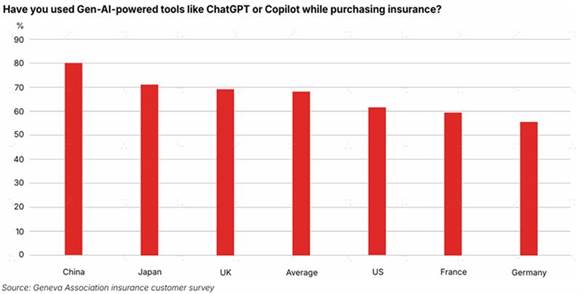
Consumers are increasingly comfortable using AI tools for information gathering and product comparison when purchasing insurance. According to the survey by Geneva Association, 68% of respondents have utilized AI assistants (e.g. ChatGPT, Co-pilot) in their insurance purchasing process [10].
Figure 3: Gen-AI-Powered Tools Application Across Countries
Operational Restructure of Life Insurers
Channel Cost Efficiency
The costs of the agency distribution channel consist of three major categories including commissions, incentives and fixed expenses. Commissions include first year commission (FYC) and renewal year commission (RYC). FYC generally ranges from 20% to 30% of first year premium (FYP) in mainland China. Regular incentives generally equal 80% to 100% of FYC, consisting of individual sales bonus, recruitment bonus and team productivity bonus which are formally defined in Agency Compensation Scheme. Additional incentives, including contests and awards, generally account for another 10% of FYP [11]. When office rent, staff salaries, training expenditures and other daily operational expenses are taken into account, total expenses could hit approximately 70% of FYP before accounting for claim payouts.
By contrast, the online insurance channel eliminates most of these costs. There is no heavy expenditure on commissions and incentives. It is no need to sustain numerous office premises, nor to deliver systematic training to the sales team. Under the regulatory framework for internet insurance cost, the average additional expense rate for individual internet insurance products with a coverage period exceeding one year should not exceed 25%[12].
Digital Strength of Online Distribution
From the perspective of life insurers, the main functions of traditional agents are lead generation and conversion. However, at the stage of booming internet and digital transformation, most of these responsibilities could be largely replaced by digital solutions which generate larger traffic volumes with far lower expense.
ZhongAn Insurance demonstrates that an insurer can achieve scalable profitability without human agents. As a purely internet insurer, ZhongAn embeds its products directly into digital consumption scenarios including online shopping, ridehailing and travel services, capturing potential customers precisely at the moments of intent. The result represents not merely business expansion but an entire improvement in cost structure. In 2025, its premium from health ecosystem increased by 22.7% compared with the previous year while compressing the expense ratio by 6.7 percentage points attributed to efficiency improvement by AI [13]. For a traditional life insurer primarily relying on agency distribution, it is almost impossible to expand business scale while reducing costs as larger scale implies more investment in management and incentives.
Huize operates as a leading digital insurance intermediary platform. As an online platform aggregating life and health products from multiple insurance companies, Huize replaces the agent’s role in product comparison and explanation. In 2025, self‑service policy purchases increased by 50% compared to the previous year powered by AI solutions. Driven by the consistent implementation of AI strategy, the expense‑to‑income ratio improved by 5.9 percentage points [14]. Each policy sold through Huize incurs a lower cost than one sold by a human agent, as AI tools deliver expert consulting services and remove the need for sales advisors entirely.
Taken together, these two examples demonstrate that online ecosystems have achieved functional equivalence with human agents in prospecting and policy conversion, while operating on fundamentally leaner costs. For life insurers, the question is no longer whether online channels can replace human agents, but more importantly how to reallocate resources accordingly.
Advances in Artificial Intelligence Technology
An Illustrative Case: AI Consultation in Medical Fields
A major breakthrough of AI in the medical industry demonstrates that AI can handle high-barrier, unstandardized tasks once deemed exclusive to human experts. AQ (also known as Ant A-Fu), an AIpowered health assistant developed by Ant Group provides compelling evidence.
AQ delivers medical Q&A services, radiological imaging interpretation, and health record administration. It also provides access to licensed doctors for online consultations and prescription services. For instance, the platform's AI model can accurately identify over 100 types of common skin conditions [15] and interpret 99% of standard medical reports with over 95% accuracy [16]. More significantly, over 1,000 leading physicians established "AI digital twins" on the platform. These AI doctors have collectively answered more than 27 million in-depth health consultations [17]. By early 2026, AQ's total registered users had surpassed 100 million [18], making it the world's largest AI application in medical and healthcare. Its monthly active users reached 30 million by January 2026[16]. The platform now handles over 10 million daily health queries [16].
AQ has proven that high-barrier consultative services, which require medical knowledge, diagnostic reasoning, and personalized communication, can be effectively commoditized through AI. Since AI can handle complicated tasks in the medical field that require advanced professional certification, the technical path for fully automated insurance distribution is highly feasible. The AI insurance advisor can certainly handle risk identification, needs analysis, solution recommendation and product interpretation.
AI Deployment in Life Insurance
Besides cross-industry evidence from the medical sector, existing empirical research confirms that generative AI has mastered the complex, non-standardized tasks in creative and interactive contexts. Experimental evidence demonstrates that AI can autonomously execute knowledge-intensive tasks with high efficiency and quality that rival human performance [19].
The insurance industry has already adopted AI capabilities in multiple scenarios. A 2025 survey by Moody's Ratings covering 21 insurers across five major APAC markets shows that over 80% of respondents are using AI and realizing benefits. Their main application scenarios are related to marketing and distribution in which Insurers apply AI to generate marketing materials, analysis customer needs, and draft talking points for sales consultations. Moreover, more than 60% of surveyed insurers use AI in customer service. Chinese insurers have benefited from AI more extensively than their peers in other parts of APAC [20].
Practical cases also provide strong evidence that AI is reshaping the insurance industry. In China, Ant Insurance launched "Sheng Xin Pei", an AI-powered personal insurance planning tool, in April 2023. This tool can generate personalized insurance portfolios within 30 seconds through intelligent models based on users' age, budget and insurance needs while saving up to 30% of budget [21]. Another typical example is an AI-powered sales agent developed by Lingxi Technology. It can construct customer profiles, identify customer needs based on data captured, and further conduct personalized sales flows without human intervention. It delivered a 200% improvement in sales efficiency and drove a 30% revenue increase in the pilot on converting the sleeping customers [22]. Looking to global industry practice, Allianz ‘s Fusion® platform serves as an AIpowered quotation engine providing tailored insurance offers based on customers’ itinerary data. The system generates over one billion personalized quotations annually for more than 900 customer segments and delivers approximately 15% annual insurance revenue gain [23]. For agency distribution, Bajaj Life Insurance launched SmartPitch, a GenAI platform that can dynamically customize sales conversations according to distinctive customer profiles. It contains 5.5 million pitch combinations adapted in real-time to help agents handle objections and explain product benefits [24].
Taken together, AI is reshaping foundational sales work within the insurance industry including customer analysis, product matching and policy interpretation. The traditional role of human agents as an informational intermediary is no longer competitive.
Empathy Capabilities of Modern AI
When discussing whether AI could replace human agents, the most controversial point lies in empathy which is deemed as an exclusive capability to human beings. Empirical evidence challenges this assumption.
By comparing physician and AI chatbot responses to patient questions in a recent study, it is concluded that the chatbot responses are preferred and rated significantly higher for both quality and empathy. Evaluators gravitated toward chatbot responses in 78.6% of the 585 evaluations [25]. This finding has profound implications for the implementation of AI in industries where trust and empathy are crucial.
Another study demonstrates that it is feasible and effective to incorporate empathy into AI chatbots by encoding specific linguistic patterns and emotional tones. This enables more emotionally engaging interactions and elevates service experience [26]. Their research confirms that AI's emotional intelligence is not a theoretical possibility but an empirically validated capability.
Applied to life insurance, these findings indicate that AI systems can generate trust and emotional connection traditionally provided by human agents. If patients perceive AI as more empathetic than physicians in sensitive health contexts, then insurance consumers are likely to accept AI advisors in the financial planning fields with comparatively lower risk.
Boundaries & Challenges
Algorithmic Bias
Human agents may mislead customers for their own financial benefits. Comparable risks persist within AI-powered sales system as well, which can be defined as algorithmic misselling. Unlike human behavior, biased or deceptive suggestions generated by algorithms are difficult to detect. Malicious parties could deliberately feed biased training data into AI system, which is known as data poisoning [27], causing the AI to generate distorted product comparisons, overemphasize partial benefits and ultimately steer customers toward inappropriate choices. This “selective blindness” is not intentional in human sense, but it is structurally more dangerous because it scales across millions of interactions. Since deep neural networks function as black boxes, making it difficult to trace the rationale behind specific product recommendations or comparative analyses, such lack of transparency would gradually weaken trust among consumers.
Given this latent risk, China ‘s National Financial Regulatory Administration (NFRA) issued the 2026 Guiding Opinions secure AI deployment within Banking and Insurance sectors. The document requires that financial institutions incorporate AI risks into a comprehensive risk management framework. It also emphasizes mitigating the reliability risks caused by the black-box issue. In high-risk processes, human supervision and intervention are essential [28]. From an operational perspective, we propose a set of mitigation measures below. As the primary layer of risk control, it is necessary to construct a grading system that ranks content sources according to their credibility levels. For instance, materials released from certified authorities hold higher credibility than user-generated content. Content sources that fail to meet minimum trust rating will be blocked from deployment. Secondly, platforms should ensure the traceability of content. Complementing the above two mechanisms, all platforms must provide accessible channels where users can share their feedback and complaints. Platform operators should conduct periodic reviews to adjust their utilization of content sources in response to feedback from users. Ultimately, the ratings of content sources will be continuously adjusted based on the deployment by front-end platforms. Sources that fall below the acceptable grade will be eliminated to maintain output quality and user trust.
Data Privacy
To deliver tailored insurance recommendations, AI systems need access to large volumes of sensitive data including financial records, medical histories and behavioral patterns, introducing profound risks of data security and user privacy. China has introduced a number of regulatory responses to these challenges. Financial institutions should incorporate AI data security into their enterprise data security management systems and strictly implement the requirements for classified data protection. Also, it is required to standardize the development process, enforce strict data access permissions and improve data masking specifications. Personal identifiable information and private data should not be used for training AI models [28].
We believe that insurance companies should prudently reassess whether their current data lifecycle management practices meet the requirements of the Artificial Intelligence era. During the data collection phase, institutions should abide by the principle of data minimization, collecting only the data strictly necessary for the specific AI application scenarios. In addition, all information transfers must rely on encrypted transmission protocols. Organizations also need to apply rigorous de-identification to achieve anonymized storage. In addition, operators need to conduct periodic reviews and delete outdated or redundant data. Alongside these cleanup routines, strict segmented access permissions must be implemented to limit data access to those whose job duties genuinely require such information. To add another vital layer of protection, it is essential to prohibit AI algorithms from inferring personal identity by analyzing seemingly anonymous interaction data across multiple sessions through contextual analysis.
Structural Unemployment
AI is not creating a new employment crisis for insurance agents. It is merely accelerating the industry-wide transformation. The population of life insurance agents has already undergone substantial shrinkage as public insurance awareness rises and regulators push for high-quality development rather than manpower-driven model.
Generative AI has mastered core tasks including need analysis, product matching and policy explanation which once belonged solely to human agents. Such technical progress builds practical prerequisites for AI to replace traditional agents. In addition, consumer acceptance of AI-driven advisory services is rising, drastically reducing public reliance on human agents. Together, these two forces jointly drive the replacement of traditional agents by AI.
Even so, the displacement will not achieve overnight but a gradual transition. Insurers ought to reshape their strategy to shift agents from purely salesperson to trusted advisors and lifelong partners of customers, delivering holistic financial planning throughout the entire customer lifecycle. Their natural competitive advantage will lie in certain groups of customers such as high-net-worth individuals with complicated risk exposure and elderly customers preferring human interaction.
Conclusion
As AI continues to develop, it will expand service coverage throughout the entire customer journey. It can deliver scalable and personalized services across the whole business value chain including identifying protection needs, performing quantitative risk assessment, explaining policy clauses, contrasting various insurance plans and offering round-the-clock after-sales services. For this reason, human agents whose original job positioning highly focused on product selling will gradually fade out of the market.
Looking ahead, in the fully mature market, life insurance distribution will be operated through the collaboration between AI and a small group of elite human advisors. AI will possess robust capabilities to resolve most routine and moderately complex consulting requests. It will take full responsibility for high-volume tasks including demand screening, risk computation, objective product comparison and daily after-sales maintenance. The vast majority of ordinary customers with general consulting needs will be served by AI. Human advisors will be retained to deliver comprehensive financial plannings for customers with intricate requirements. These highly complex scenarios demand core strengths containing nuanced professional judgment, sustained emotional connection and highly customized guidance that algorithmic intelligence is not able to fully replace. In summary, industry-wide transformation powered by AI is no longer a matter of whether it will arrive, but how soon it will occur. Instead of eliminating human agents entirely, the industry will undergo a thorough reposition of agent roles, creating a mutually complementary ecosystem combining AI services and high-value human advisory services.
Recommendations
Life insurers should decisively develop online channels to achieve large-scale prospect acquisition through scenario-based approaches such as travel and sports. Meanwhile, they need to continuously interact with customers via digital ecosystems to enrich customer profiles. More importantly, it is essential to prioritize the development of AI as a core corporate strategy. AI should be applied to all aspects of customer engagement and service. This not only drives efficiency gains through boosting the accuracy of customer need identification and solution matching, bust also helps bring down operational costs. Furthermore, life insurers should recruit agents under more rigorous standards and revamp training curricula. Shifting the focus beyond life insurance sales to strengthen agents’ ability to tackle complex needs throughout customers’ full life cycle.
From the perspective of human agents, facing the pressure of being substituted, they must complete a thorough transformation to build competitive advantages that AI cannot easily replicate. Rather than acting as sales-oriented promoters chasing policy sales volume, they ought to reposition themselves as lifetime partner and advisor of customer. They need to comprehensively upgrade their overall professional capabilities. Beyond mastering diverse life insurance products, they need to build interdisciplinary expertise covering health management, retirement planning, inheritance arrangement and comprehensive financial management. This allows them to develop end-to-end integrated proficiency across the full financial value chain, equipping them to better adapt to the AI era.
References
- Sina Finance. (2026, May 19). From 9.12 million to 2.12 million: Behind the Insurance Agent "Reshuffle". Retrieved from: https://baijiahao.baidu.com/s?for=pc&id=1865619959384903442&wfr=spider
- Wu, S. Y. (2025, February 27). The evolution of the global life insurance industry (Japan Chapter): From collapse to revival – The formation of elite agent distribution model. Retrieved from:
- https://zhuanlan.zhihu.com/p/26705715336
- AM Best. (2011). Search for Tomorrow. Best’s Review. Retreived from https://news.ambest.com/articlecontent.aspx?pc=1009&AltSrc=108&refnum=192971
- Tsinghua PBC School of Finance, China Insurance and Pension Research Center, & Yuanbao Group. (2024). China Internet Insurance Development Report (2024). Retrieved from: https://www.pbcsf.tsinghua.edu.cn/__local/1/D4/62/CD205CF90292FEC5C7C5105550C_A05F444E_38FDC8.pdf
- Choice Mutual. (2026, March 9). Life insurance statistics, facts, and industry trends for 2026. Retrieved from: https://choicemutual.com/original-research/life-insurance-statistics/
- Tsinghua PBC School of Finance, China Insurance and Pension Research Center, & Yuanbao Group. (2026). 2025 China Internet Insurance Consumer Insight Report. https://www.pbcsf.tsinghua.edu.cn/info/1512/10405.htm
- Business Insurance. (2022, January). Agents Win Battle Against Tech-Driven Insurance Shopping. Retrieved from: https://www.businessinsurance.com/Agents-win-battle-against-tech-driven-insurance-shopping/
- Daily Economic News. (2025, May 29). Report: Post-95s' Online Insurance Purchase Rate Reaches 84%, Becoming the Highest Among All Age Groups. China Economic Net. Retrieved from: http://finance1.ce.cn/insurance1/scrollnews/202505/t20250529_2310462.shtml
- Lumineau, F., Schilke, O., & Wang, W. (2023). Organizational Trust in The Age of The Fourth Industrial Revolution: Shifts in The Form, Production, and Targets of Trust. Journal of Management Inquiry, *32*(1), 21–34. Retrieved from: https://www.academia.edu/90819304/Organizational_Trust_in_the_Age_of_the_Fourth_Industrial_Revolution_Shifts_in_the_Form_Production_and_Targets_of_Trust?sm=b&rhid=41351013139
- Geneva Association. (2025). Gen AI in the Insurance Customer Journey. November. Retrieved from: https://www.genevaassociation.org/sites/default/files/2025-11/ai_journey_report_211125_final.pdf
- Finance Observer (2023) Analysis of GDP per Capita and Insurance Density Trends from 2016 to 2025, Baijiahao, 15 August. Retrieved from: https://baijiahao.baidu.com/s?id=1702051032217742233&wfr=spider&for=pc
- China Banking and Insurance Regulatory Commission. (2021, October 12). Notice of the General Office of the China Banking and Insurance Regulatory Commission on Further Regulating the Online Personal Insurance Business of Insurance Institutions (No. 108 [2021] of the CBIRC General Office). https://www.gov.cn/zhengce/zhengceku/2021-10/23/content_5644435.htm
- China Net Finance. (2026, March 20) Zhongan Insurance Achieved Adjusted Net Profit of RMB 1.8 billion in 2025, Underwriting Profit Contributed RMB 1.412 Billion. Sina Finance. Retrieved from: https://finance.sina.com.cn/stock/relnews/hk/2026-03-20/doc-inhrqyif6950483.shtml
- Huize Holding Limited. (2026, March 27). Exhibit 99.1: Reports Unaudited Financial Results for the Second Half and Full Year 2025. U.S. Securities and Exchange Commission. Retrieved from: https://www.sec.gov/Archives/edgar/data/1778982/000119312526127767/d48518dex991.htm
- China National Radio. (2026, June 15). Ant A-Fu Pilots “AI + Doctor” Model: AI Answers Can be Reviewed by Doctors, 15% of Users Opt in. Retrieved from: https://tech.cnr.cn/techph/20260615/t20260615_527661263.shtml
- Wu, Q. Y. (2026, February 12). AI Becomes a Helpful Assistant in Health Management. People's Daily, p. 11. http://kpzg.people.com.cn/n1/2026/0212/c404214-40664342.html
- Tech in Asia. (2025, December 15). Ant Group upgrades AI health app AQ. Retreived from: https://www.techinasia.com/news/ant-group-upgrades-ai-health-app-aq
- Economic Information Daily. (2026, February 23). Ant's AI Business Accelerates During Spring Festival: Alipay "AI Pay" And Ant A-Fu App Both Exceed 100 Million Users. Retrieved from: http://jjckb.xinhuanet.com/20260223/e09fc2c5fcb74d49b17d32d34600f04b/c.html
- Noy, S., & Zhang, W. (2023). Experimental Evidence on The Productivity Effects of Generative Artificial Intelligence. Science, *381*(6654), 187–192. https://economics.mit.edu/sites/default/files/inline-files/Noy_Zhang_1.pdf
- Moody's Ratings. (2025). Insurance-Asia-Pacific: Use of Artificial Intelligence is Prevalent and Brings Benefits, But Challenges Remain. Moody's Corporation. Retrived from: https://www.moodysmismicrosite.com/details/683
- Tsinghua PBC School of Finance, China Insurance and Pension Research Center, & Yuanbao Group. (2024). China Internet Insurance Development Report (2024). Retrieved from: https://www.pbcsf.tsinghua.edu.cn/__local/1/D4/62/CD205CF90292FEC5C7C5105550C_A05F444E_38FDC8.pdf
* Ping An Life Insurance Company & China Academy of Information and Communications Technology (CAICT). (2026). Insurance Industry AI Agent Implementation Roadmap Research Report (2025). Retrieved from: https://www.fxbaogao.com/view?id=5267792 - Allianz Partners. (n.d.). Allianz Fusion. Retrived from: https://www.allianzworldwidepartners.com/usa/products-and-solutions/allianz-fusion-core.html
- The Digital Insurer. (2025, October 13). Insurer Innovation Showcase Award Winner 2025 – Bajaj Allianz Life Insurance. Retrieved from: https://www.the-digital-insurer.com/tdi-awards-2025/insurer-innovation-showcase-award-winner-2025-bajaj-allianz-life-insurance/
- Ayers, J. W., Poliak, A., Dredze, M., Leas, E. C., Zhu, Z., Kelley, J. B., Faix, D. J., Goodman, A. M., Longhurst, C. A., Hogarth, M., & Smith, D. M. (2023). Comparing Physician and Artificial Intelligence Chatbot Responses to Patient Questions Posted to a Public Social Media Forum. JAMA Internal Medicine, 183(6), 589–596. Retrieved from: https://doi.org/10.1001/jamainternmed.2023.1838
- Rohden, S. F., & Espartel, L. B. (2026). Emotional Artificial Intelligence: The Impact of Chatbot Empathy and Emotional Tone on Consumer Satisfaction and Word of Mouth. International Journal of Human-Computer Studies, *210*, Article 103764. https://doi.org/10.1016/j.ijhcs.2026.103764
- Oprea, A., Singhal, A., & Vassilev, A. (2022). Poisoning Attacks Against Machine Learning: Can Machine Learning Be Trustworthy? Retrieved from: https://tsapps.nist.gov/publication/get_pdf.cfm?pub_id=934932
- National Financial Regulatory Administration. (2026, June 18). Guiding Opinions on the Safe Development and Application of Artificial Intelligence in the Banking and Insurance Industries (NFRA Document No. 8 [2026]). Retrieved from: https://www.nfra.gov.cn/cn/view/pages/ItemDetail.html?docId=1261784&itemId=928[reference:0]