

Possible Futures of (Re)insurance through the AI Revolution
Malik Abbassi-Antoine, Chief Market Development Officer, Europe, Lloyd’s Insurance Company
Elon Musk's science-fiction theories and their implications for (re)insurance
Executive summary
AI is on everyone’s lips, labelled as the treatment for the world’s problems, debated as the source of new abundance. This paper takes one of those promises seriously – a world where work and scarcity have largely disappeared – not as a forecast, but as a stress test of (re)insurance relevance.
For (re)insurance, AI has too long been a matter of operational efficiency. Yet, it raises more fundamental questions: what we insure, whom we insure, how insurance is bought, how it is delivered.
AI will not make (re)insurance disappear; it will redistribute insurable interest – and with it, premium, margins, distribution and people.
This paper sketches three scenarios of “AI’s wealth redistribution” for 2051 — continuity, abundance concentrated in few hands, and a State that captures the surplus — and follows the money: which risks grow, which shrink, who underwrites them and who distributes them.
Beneath their differences, the scenarios ask one question: who ends up holding the risk – the market, the balance sheets of the few, or the State. Four calls follow, for the industry and for the (re)insurance leaders:
- Collectively, keep the risk in the market, be it in conquering the new AI-driven risk frontier in P&C or in defending the daily “bread and butter” in life and health.
- In non-life, organise now – a common taxonomy for AI risk, shared loss data, an accumulation registry, model clauses, pool and backstop design – so that (re)insurance underwrites the AI value chain rather than watches it.
- In life and health, where premium follows the median household, weigh in on how AI’s surplus is shared: measure displacement with our data, design the private complement, administer public schemes.
- Actively shape AI rules and governance in (re)insurance to ensure the industry has the right to use AI, to the extent individually accretive benefits do not lead to corrosive impacts, collectively.
- Individually, the changes ahead are commercial, financial and human at once; they belong on CEO agendas, not in innovation labs.
1. Musk's predictions: A world without work or scarcity
Over recent months, Elon Musk has repeatedly predicted an era where, by virtue of AI, robots and automation deployed at global scale, humans would no longer need to work or save, and anyone may have anything they want.
The idea of a universal income is not new, but its recurrence in Silicon Valley speeches has sharply increased — regardless of ultimate motivations. Nor are wealth displacements new; each industrial revolution moved capital and work.
Then why would Musk's predictions matter for (re)insurers when, looking at the past, we can comfort ourselves that (re)insurance has always evolved with industrial revolutions, covering new assets and risks, and enabling economic change whatever its direction?
First, because AI moves beyond execution into knowledge work. Second, the paradigm looks different this time. Insurance depends on an interest, from someone, over an asset (tangible or intangible), and on an identifiable party suffering an actual loss from a defined event. In the world described above, why would you insure anything when assets can be replaced at no cost? How do you value a loss? Who holds an insurable interest when assets, incomes and liabilities have migrated to a handful of machine owners or to the State, and when millions of knowledge workers have lost buying power? In short: where is (re)insurance still relevant?
2. What’s assumed and what’s not: Three scenarios, one question
2.1. Limitations
This paper aims at thought provocation and will not test every dependency behind AI development’s scale and pace. The factors below will not be discussed, though each may drive an uneven end-state and timeline:
- Capital: The sufficiency of capital necessary to fund AI development at such scale, and the adequacy of absolute return and time horizon.
- Climate and energy: Data centres' electricity and water consumption grows exponentially; chips and robots are rare-earth hungry; many facilities sit in water-stressed basins and nat-cat exposed areas.
- Demographics: How ageing plays in AI funding and usage. Is displacement an issue when the world's population is no longer needed or able to work?
- Fiscal exhaustion: Public balance sheets are stretched; further charges to the public sector will trigger new controls, starting with taxation.
- Geopolitics: Chips and model access have become a political variable, leading to commercial — possibly military — conflicts. Two nations outpace the rest, with no multilateral framework for AI governance or for redistributing its wealth.
- Macroeconomics and the cost of AI: Do AI, automation and robotisation create growth on a net basis, once capital, usage and social displacement externalities are accounted for?
- Social acceptance: Humans accepting to "become AI's pets" is not warranted. Change at this scale produces fear and rejection, expressed peacefully (legislation) or less so (Luddism).
- “Terminator” scenario: AI scales down — moratorium after misuse, or worse, scales to the point where humans are eradicated.
2.2. Assumptions
And yet, because the DNA of (re)insurance is to anticipate and price the future, let’s accept Musk's predictions over 25 years, factoring only one variable: who owns "AI-produced wealth" and what it means for the (re)insurance industry, assuming three scenarios.
- Scenario A: Continuity
AI gains are partially taxed and redistributed. Welfare State persists, though pensions remain strained, health and social systems rationed. We remain on 2026 trends: The World Economic Forum projects 170 million jobs created and 92 million displaced by 2030. Households continue to save, borrow, retire and worry about outliving their money. Corporates automate incrementally.
- Scenario B: Abundance for a few
Wealth accrues to those who own models, compute, energy and robots. Taxation of capital fails and labour’s share of income collapses without offsetting transfers. Households become asset and cash poor, and a narrow extraordinarily wealthy owner class enjoys abundance. State is fiscally weak and increasingly incapable of dealing with permanent social unrest.
- Scenario C: State takes it all
State captures AI surplus – through equity stakes in AI champions, compute levies or nationalisation — and administers it as universal income. Households receive transfers and hold little private financial risk. Corporates operate inside licensing regimes, with public procurement shaping demand. State becomes the insurer of first resort.
***
The core belief for this paper is that the three scenarios will follow each other sequentially — from A, to B, to C — or blend, depending on choices made; with seeds of C already visible in increasing public intervention.
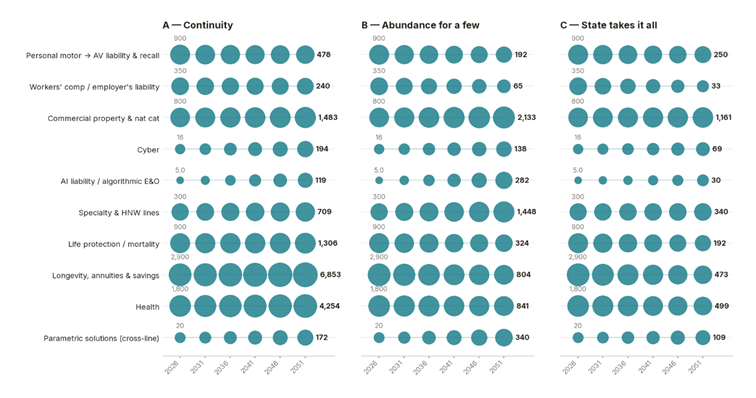
Baseline is Swiss Re's: real premium growth at a cyclical low of 1.3% in 2026, returning towards its ~2% trend after 2027. Scenario A roughly doubles real GWP over twenty-five years; B leaves it broadly flat; C shrinks the private market by more than half.
Chart 1: GWP growth projections by class of risk and scenario (US$ billion)
3. Where scenarios converge: AI risk grows, workforce shrinks
3.1. Classes and servicing: Technology-related risk and parametric in, motor out
Commercial Property, Cyber, high-net-worth products and services and Specialty grow in each scenario. Property catastrophe is the least disturbed line: physical exposure grows with data-centre and grid build-out and protection gaps remain enormous, ~USD 1 trillion a year (Cyber and Nat Cat). Motor, a traditional portfolio bedrock, is structurally exposed as autonomy advances: liability migrates from driver to manufacturer and software suppliers; a high-frequency retail pool becomes low-frequency, high-severity product-liability and recall exposure.
Servicing: Parametric "insurance" grows significantly in each scenario. AI makes more perils modellable, indices cheaper to audit and settlement adjuster-free; fits machine-to-machine distribution; and some argue that standardised triggers, such as power-supply interruption for data centres, generate the loss data capital markets need to securitise the digital infrastructure.
3.2. Economics: Real gains and the risk of exclusion
Loss management improves through prevention: tropical-cyclone forecasting, wildfire detection, or AI-designed drugs. Risks once uninsurable for lack of data become priceable. Net gain depends on the losses AI prevents and on who owns the data and orchestrates ancillary services: (re)insurers, or model owners? Risk by risk, AI makes profitability more predictable – and may exclude rather than include. In scenarios A and B, individuals and SMEs become uninsurable for lack of insurable interest or affordability. Growth of "uninsured" pools in A and B will trigger public intervention.
On expense ratios, AI is expected to cut up to 25% in operating costs and loss-adjustment, and leakage by 30% to 50%. History commands prudence though: normalised for rates increase and inflation, expense ratios did not improve over 2018-2023.
3.3. People: Around one million roles out?
(Re)insurance is one of the most automatable industries. World Economic Forum expects that up to 70% of the work performed in insurance has high potential for automation and augmentation. Task-level analysis scores underwriters, claims and policy-processing clerks at 100% automation or augmentation potential. Scaled globally, the (re)insurance employment base is ~6 million direct employees (excluding distribution); assuming a fully automatable share of 30% puts ~2 million FTE in scope. Three factors offset that number: retirements; regulators mandating human accountability; and new roles (e.g. model governance, AI audit, data engineering). One can reasonably assume that ~1 million FTEs will be removed over twenty-five years, concentrated in underwriting, claims and policy administration.
4. Where scenarios split pace and destination
4.1. Classes: Social settlement decides biggest pools
Group Health, Life, Protection and Savings are highly sensitive to social models and household prosperity: Whilst growing in Scenario A, they decline massively in B and morph in C towards advisory, reinsurance and financial structuring for public buyers. The sharpest question is longevity and savings. If Musk's advice were followed, the consequence is not the end of longevity risk but its transfer: households that stop accumulating do not stop ageing. The pension protection gap already runs around USD 1 trillion a year; it widens into destitution in B, sustains in-force and asset-intensive reinsurance in A, and is nationalised in C.
In other classes and segments, whilst directional trend is shared, pace and implications differ.
In Scenario A: Mass market continues to grow with inflation, refocusing on income protection (from property P&C and motor retail to L&H) and products for wealthy segments. Households remain buyers; purchases shift from replacing physical things towards income continuity, health, care and longevity. In Commercial lines, corporates buy more liability as value migrates to intangibles and Property cat growth is supported by tech and energy. Employers keep buying group benefits, though the pie shrinks as displacement begins. The strategic risk is not obsolescence but margin erosion in commoditised lines while profitable complexity moves elsewhere. Value continues its migration from the “what” to the “how”: delegated authority, analytics, services and structured solutions.
In Scenario B: Insurable interest concentrates. Market becomes smaller in reach and larger in average risk size; margins concentrate where data and capital are scarce. Personal lines decrease on mass-market as consumers' ability to pay decreases. At most, households purchase compulsory motor and basic health coverage. Life, savings and annuities shrink, not for lack of demand but for lack of affordability and insurable interest. Growth sits at the extremes: high-net-worth business booms in line with asset base and needs complexity — property, political violence, health (PMI), liability. In Commercial lines, Tech drives demand around the automated asset base: property and business interruption on data centres and robotics fleets, contingent cover on compute and energy supply chains, algorithmic errors-and-omissions for model owners, and specialty classes for a more troubled world (war, terrorism, credit and guarantees). In health, group schemes shrink with unemployment and workforce reshaping (“from workers' health to robots' production continuity”).
In Scenario C, private GWP contracts (individual property remains marginally, for what is not replaceable) as State absorbs primary risk, orchestrates everything and buys reinsurance and services rather than insurance. If public transfers replace labour income, household exposure to mortality, disability and unemployment is socialised; the residual private market is narrow, top-up in character. State's balance sheet then carries aggregate volatility: catastrophe, pandemic, systemic model failure, longevity drift across a whole population. Industry’s role shifts from millions of small contracts to capital, analytics and underwriting governance for large public schemes.
4.2. Distribution: Advice survives, search-and-quote does not
Search, comparison, documentation, administration are tasks LLMs will eventually perform at near-zero marginal cost. Personal advice is still desired for complex matters and claims, yet a majority of customers already use AI tools when buying insurance.
Distribution as we know it survives only in Scenario A — and even there it compresses: search-and-quote commoditises while advice holds. AI agents cut margins out of motor, home, travel and simple SME lines. Complex commercial broking is resilient: clients buy a suite of services — aggregation management, wordings, claims advocacy. Growth accrues to whoever controls the point of demand — manufacturers, platforms, banks, AI assistants. The most valuable position belongs to whoever operates machine-readable appetites, authority and wordings that other AI agents can transact against.
Scenario B accelerates the above and retail distribution economics break. With little to insure and less to spend, acquiring a household costs more than its lifetime value; tied-agent, retail-broker and comparison-site models contract. Compulsory cover embedded in the vehicle, the device, the tenancy — sold machine-to-machine, a household's AI agent transacting against a carrier's pricing API, develops rapidly. At the top of the market, private-client advisory and specialty placement become more relationship-intensive.
In Scenario C, the State administering universal income and social protection also administers distribution: enrolment is automatic and free. Private distribution is confined to top-up, occupational and high-net-worth products, and to the wholesale layer. Intermediaries look less like brokers and more like actuarial and capital-markets advisers to governments.
Across all three, defensible positions are the top of the complexity curve, proprietary data and analytics, or the machine-readable rails (which you may label “embedded”, “machine-to-machine”, “facilitised”, the question is between whom those rails are set – certainly areas where agile and versatile tech infrastructures will win). Commission on simple products is a rent AI will compete away. For large brokers the question becomes the defence of USD 47 billion in intermediation revenue. Partly by climbing — advice, analytics and investment-banking-like capital advisory. Partly by descending into underwriting economics: Facilitisation, MGA and delegated-authority platforms convert distribution strength into underwriting margin without a balance sheet.
5. From passenger to steward: The collective game
Implications differ by side of the fence: Non-life is a technical discussion – who holds the risk, and how; life and health depend on social construct and wealth redistribution. In aggregate, the stake is the USD 13 trillion of premium separating Scenario A from Scenario C in 2051.
5.1. Non-Life: Make AI risk insurable
Growth is fuelled by AI build-out and operating at scale by 2051. Most of what is underwritten revolves around AI-generated risk, physical or not, whichever scenario wins. The build-out only happens at pace if it is financeable, and it is financeable only if it is insurable. A market unable to define, measure and pool AI risk pushes it to the owners and operators (captives), or to the State. If solutions are not available, stakeholders will design theirs and they have done it before: When commercial capacity failed them, energy majors built their own mutual (OIL, 1972) and shipowners their P&I clubs. Model owners can do the same.
However, risk severity and aggregation have grown many-fold in that world, and three market failures that no carrier can fix alone stand in the way.
First, accumulation is a commons problem: each insurer sees its own exposure to a given model or cloud region; nobody sees the market’s. A systemic event hits everyone simultaneously — the one risk that can neither be diversified nor measured alone.
Second, wording chaos is a correlated legal risk. The cyber precedent should be remembered: a decade of silent exposure, years of litigation over what constitutes an “event”, and a market that stalled as a result. If every carrier invents its own definition of model failure, the litigation of 2035 is already written.
Third, no backstop was ever negotiated bilaterally. Nuclear, terrorism, natural catastrophes: every precedent required an industry speaking with one voice and holding market-wide data. Arrive without a design, and you receive the regulator’s.
Coordination is required where risk is correlated across the market and no single firm can correct it. Five items on the agenda:
- A common taxonomy: the precondition to everything else.
- Anonymised loss-data sharing: it is what made catastrophe risk modellable in the 1990s.
- An accumulation registry: market exposure by model, cloud and site; commercially sensitive, therefore aggregated first and held by a trusted third party.
- Model clauses: Mechanical once the taxonomy exists.
- Pool design and the backstop: the highest value and the least feasible today, only credible once the first three exist. Each step makes the next one possible.
How? All of this is obvious on paper and harder in practice. All can free-ride; first movers pay and reveal; those with the best data have little interest in transparency.
Three answers: The sequence starts antitrust safe and cheap. Then, reinsurers hold the correlated tail, hence the incentive to fund the commons through the existing machinery – market associations and supervisory fora. And several precedents, from terrorism pools to cyber wordings, were built after the loss: the only real choice is paying the coordination cost before the event or after it.
5.2. Life and Health: No middle class, no market
70% of today’s premium sits in classes whose size in 2051 depends less on any model than on how AI’s surplus is shared. There is self-interest here, not philanthropy: Insurance is a derivative of shared prosperity, penetration follows the median household, not the average. Our industry’s greatest growth era – the three post-war decades – rode on wage and welfare settlements insurers did not design. Scenario B empties the middle class, and Scenario C nationalises it. A sector whose addressable market hangs on that sharing cannot sit out the redistribution and universal-income debate. Last century we were passengers of the social contract, this time we should help write it.
How? With the same discipline as the Non-Life agenda:
- Measure: we hold the best disability, income and longevity data in existence. Publish the actuarial picture of displacement before governments create one.
- Design relevant value proposition: Revamp or create new products around wage insurance for retraining, portable benefits for fractional work – the private complement to whatever settlement emerges, as occupational pensions were to Beveridge.
- Administer: Where the State pays, insurers can still run the rails of claims, fraud and administration of compulsory schemes.
- Invest: European insurers alone hold over €10 trillion of assets. This is a voice in how the transition is financed.
5.3. On both sides: Shape the rules, or inherit them
On both sides, the industry must keep the right to use AI – and the rules are being written now. Shaping them takes more than position papers. Offer the taxonomy and registry of 5.1 as the supervisory evidence base: Rules written on industry’s data are rules industry can live with. Answer consultations with draft standards rather than general comments. Run supervised pilots in regulatory sandboxes. Evidence will persuade supervisors better than lobbying on theoretical principles.
6. Survival of the fittest: The competitive game
Section 5 was collective: this one is the competitive one. Three takeaways.
6.1. Commercially: Complexity wins, undifferentiated scale loses
Global P&C and specialty carriers are advantaged in every scenario: complexity, novelty and large limits are their everyday material; their constraint is modelling credibility for AI liability, not demand. Acquiring those capabilities is key, so long as a profitable base finances the needed rebalancing.
Reinsurers win in all three scenarios — and this carries a message for primary insurers: disintermediation. In A, value migrates to whoever operates the machine-readable rails; in B, owner-class clients and model owners may retain frequency risk (balance sheet or captives) and cede severity straight to reinsurers; in C, the State buys reinsurance and advice, not insurance. Wherever the primary layer stops adding underwriting or distribution value, capital connects to risk without it. Brokers’ facilitisation play is a reverse threat to carriers’ traditional intermediation. Client relationship, services and structuring agility help keep a seat at the table.
Domestic L&H and P&C monoliners writing undifferentiated retail and SME risk are on the wrong side of every trajectory: highly exposed in B and C, defensible in A only on cost efficiency and the ability to drastically cut distribution costs. Composites without scale inherit both problems.
6.2. Organisationally: Protect the judgement pipeline
People: Do not let the efficiency imperative be the only driver. Social displacements, demographic changes, new skills and upskilling carry strategic, commercial and human consequences alike. Whilst it matters little in Scenario C, it must be factored in A and B. First, because the pipeline breaks before senior population does: automate entry-level underwriting, claims and analyst work and we lose apprenticeship that produces judgement in fifteen years' time — a risk no treaty covers. Second, because humans bring judgement and creativity under genuine uncertainty, be it for relationship in placement, structuring or claims management.
Leadership: Organisations cannot let “AI” remain siloed within Tech, Ops, Risk or Public Affairs. They have to be led by CEOs in a holistic fashion. Inaction means constrained appetite, limited impact and, ultimately, threatened relevance.
7. Conclusion
Return to Musk. He may be describing a world twenty-five years out, one that never arrives, or — most likely — one arriving unevenly while pension deficits, catastrophe losses and social inflation carry on, regardless. The point is not the forecast; it is the value of preparedness. We price tail events for a living; we will be embarrassed to be caught without a view on the event that will reprice our own industry. Our relevance is not set in stone: (Re)insurance has survived every industrial revolution by redefining what counts as an insurable interest before someone else defined it on its behalf. Steam engine did not consult the underwriters, and neither will the model. The question is not whether Musk is right, but whether, in the world Musk describes or its degraded versions, we will still be the institution society turns to when something goes wrong — and whether we then have something to offer.
Appendix
1. Scenarios summary
| Parameter | A — Continuity | B — Abundance for a few | C — State takes it all |
|---|---|---|---|
| Wealth distribution | Broadly as today, mildly redistributed (decreasing over time) | Concentrated in model, compute, energy and robot owners | Captured and shared by the State |
| Role of the State | Welfare State (strained) | Minimal (core sovereign functions) | Maximal |
| Labour income | Reshaped, high churn | Collapsing share; gig & care | Work largely optional |
| Capital formation | Incremental, market-allocated | Vast but narrow | Directed by public vehicles |
2. Supporting table: GWP assumed projections
Scenario A is the baseline. Each class starts from a 2026 anchor estimated from the Swiss Re Sigma 2/2026 premium splits, completed for the newer pools by the studies cited in the paper. Growth ranges are deviations from sigma's ~2% real trend, selected by me. They are not forecasts.
| Class of risk | Scenario A | Scenario B | Scenario C |
|---|---|---|---|
| Personal motor → AV product liability & recall | −2 to −3%; liability to makers | −5 to −7%; severity to recall | −4 to −6%; State-administered |
| Workers' comp / employer's liability | −1 to −2%; churn offsets | −5 to −8%; employment gone | −8 to −10%; socialised |
| Commercial property & nat cat | +2 to +3%; climate-led growth | +3 to +5%; data-centre build and climate-led | +1 to +2%; public peak pools |
| Cyber | +9 to +12% | +8 to +10%; corporates mostly | +5 to +7%; State backstop caps |
| AI liability / algorithmic E&O | +12 to +15%; fills gap | +15 to +20%; largest new pool | +6 to +9%; statutory caps |
| Specialty & HNW lines | +3 to +4%; steady, complexity-led | +5 to +8%; owner-class | 0 to +1%; narrow top-up |
| Life protection / mortality | +1 to +2%; repurposed to income continuity | −3 to −5%; group withers | −5 to −7%; socialised |
| Longevity, annuities & savings | +3 to +4%; in-force deals | −4 to −6% mass; bespoke above | Private −6 to −8%; smaller top-up book, better returns |
| Health | +3 to +4%; top-up growth | −2 to −4%; PMI upmarket | Private −4 to −6%; State stop-loss |
| Parametric solutions (cross-line) | +8 to +10%; corporate and SME | +10 to +14%; embedded microcovers | +6 to +8%; sovereign schemes |
| Market total GWP (real, 2051 vs 2026) | ▲ Roughly doubles | → Broadly flat (×0.8) | ▼ Shrinks ~60% |
3. AI disclosure
I have used generative AI tools (Perplexity and Claude) as a research and editing assistant (fact checking, numerical verification and concision) while all analysis, judgements and conclusions are mine. For a paper arguing that the industry should “own” AI rather than watch it, the process was my own journey in doing so.
References
- The Future of Jobs Report 2025, WEF, 7 January 2025.
- “The New Wave of Nationalization”, Nicholas Mulder, F&D Magazine, IMF, June 2026.
- Swiss Re Institute, sigma 2/2026.
- Detailed assumptions are outlined in Appendix 2.
- Est. USD 24 billion of data-centre premiums by 2030, “Insuring AI: data centre value accumulation risks”, Swiss Re sigma insights 07/2026.
- GFIA — Global protection gaps and recommendations for bridging them, March 2023.
- “The Convergence of Financial and Reinsurance Capital”, Guy Carpenter, Laurent Rousseau, 2026.
- “A foundation model for the Earth system”, Bodnar et al, 21 May 2025, Nature.
- “Inside the launch of FireSat”, Google blog, 17 March 2025.
- “The AI-First Property and Casualty Insurer”, BCG 30 March 2026; “ The USD 100 Billion Opportunity for Generative AI in P&C Claims Handling”, Bain 31 October 2024.
- “McKinsey Global Insurance Report 2025: The Pursuit of Growth”, November 2024.
- See footnote 1 as well as “Artificial Intelligence in Financial Services”, WEF, January 2025.
- “AI and the Future of Work”, TIAA Institute, May 2025.
- See footnote 6.
- “Gen AI in the Insurance Customer Journey”, Geneva Association, 20 Nov. 2025.
- FY2025 risk and broking revenues of Marsh McLennan, Aon, WTW and Gallagher; consulting excluded.
- Quoting Swiss Re’s sigma 2/2026, “data centres full cost of construction can exceed USD 20 billion, which can double once GPUs and other technology is installed (…) the re/insurance industry can currently only support a fraction of this limit at competitive rates”.
- For illustrations, EU AI Act or NAIC Model Bulletin: Use of Artificial Intelligence Systems by Insurers.