

MGAs: Here today, Here tomorrow…?
Charlotte Halkett, Principal, Milliman
Managing General Agents – Smart Solution or Bad Bet?
Introduction
Managing General Agents (MGAs) take a special place in the insurance ecosystem today. With growth outpacing carrier metrics, outsized influence in the number of M&A deals and a thriving international community, some cite MGAs as the spearhead of innovation and the future of the industry. A visit to one of the many global MGA insurance events will reveal communities brimming with energy, growth and pace.
But this MGA-centric view certainly isn’t universal across the insurance industry, and in many ways it’s a significant shift from the recent past. MGAs don’t have the regulatory permissions of carriers, nor do they have the breadth and fleet-footed customer alignment of brokers. They’re a type of hybrid, with delegated authority to innovate, build and service a limited number of products on behalf of a carrier that must sit behind them and take ultimate responsibility.
Indeed, Evan Greenberg strongly criticized the traditional MGA model in his recent letter to shareholders – “Many reinsurers, and insurers as well, support managing general agents (MGAs), which is a bad bet in the majority of cases.” 2
So, if some of the most successful minds in our business community doubt their very value, why is the insurance industry still talking about MGAs?
For this paper, I have spoken to the insurance community, conducted in-depth research and interviewed leaders 1 across the MGA value chain. I have been asking a simple but fundamental question: Why do MGAs exist … and will they exist tomorrow?
My conclusion is that MGAs endure not because they are a temporary market inefficiency, but because they are a neat solution to a structural problem for insurance carriers: how to enable specialised focus and nimble experimentation whilst also creating strong, long-term risk management across multiple lines of business. MGAs can provide an efficient and low-risk avenue for carriers to access niche underwriting, customer proximity, specific technologies and execution speed. Furthermore, the specific focus of MGAs engenders entrepreneurial and/or specialist cultures which are hard to replicate in a generalist organisation with multiple competing priorities with long-term horizons.
MGAs and carriers can be stronger than the sum of their parts when they partner intelligently. I conclude that the future will be bright for those MGAs that maintain their value creators: deep focus on underwriting specialism, proximity to customers, technological advantage and, critically, the human touch in a world of AI.
MGAs and their global position today
What are Managing General Agents (MGAs)
A Managing General Agent (MGA) is a specialized insurance intermediary entrusted with delegated authority from one or more insurance carriers*. MGAs lack regulatory authority to write insurance on their own balance sheets, so they must partner with carriers to write business. 3
In a typical MGA–carrier relationship, the MGA manages front-end, client-facing activities, while the insurer handles back-office governance. Beyond marketing or servicing policies, an MGA can also be authorized to underwrite risks and manage claims – the exact nature of the relationship is set out in a binding authority agreement.
The carrier retains the ultimate regulatory responsibility for policies and losses and the MGA earns commission from the carrier for its role in the value chain. Carriers often work with multiple MGAs to access different markets, skills and technologies.
Global Economic Significance of the MGA Market
The global MGA Market is heterogeneous, but indications of strong growth and interest are seen across geographies:
Between 2016 and 2024, U.S. MGA-written premiums doubled, with similar momentum in the UK, Europe, Latin America, and the Middle East.
2025 MGA Gross written premiums were $122Bn in the US and $23Bn in Europe. European MGA gross written premium saw growth at 15% year-on-year, with US MGAs growing around +7% (in comparison to the wider US Property & Casualty market at 5%). UK MGAs are estimated to be associated with more than 10% of the £47Bn General Insurance Premiums. 4,5
The Asian MGA market is more nascent, but multiple sources point to opportunities for growth over the next decade. To quote a recent article in Asia Insurance Review “All the runes are suggesting that the early part of this decade is going to see a surge in interest in managing general agents around the globe but particularly in Asia”. 7 Guy Carpenter also recently described how the Asia Pacific MGA market is “poised for substantial growth in the coming years.” 6,7,8
- M&A activity is also active in the MGA space: In the UK market, MGAs contributed the most deals by count in 2024 and 2025. 9
*Note that insurance carriers are interchangeably referred to as “insurers” and “carriers” in this paper
Life and Health MGAs: it’s not just about Property & Casualty
Managing General Agents occupy a clear space in Property & Casualty lines, but what about Health Insurance and Life Insurance? Although risk types may be more homogeneous compared to the encyclopaedic P&C lines of business, the same opportunities for innovation, technology and talent exist within these critical spaces.
Recent years have seen the MGA model being utilised to drive product innovation, with examples such as:
YuLife, an MGA offering Group Health, Life, Income Protection and Dental Insurance, innovates around enhancements for employee wellbeing and gamification of customer engagement.
Healix Insurance Services uses analytics to design niche Accident & Health and travel insurance products backed by capital from Lloyd’s of London and the international markets.
How about the naysayers?
Why doesn’t Evan Greenberg like MGAs?
In the Chubb 2025 Letter to Shareholders2, CEO Evan Greenberg makes his MGA thoughts clear:
“Many reinsurers, and insurers as well, support managing general agents (MGAs), which is a bad bet in the majority of cases…”
His argument is predicated on a fundamental misalignment of underwriting interests: “Insurers who outsource underwriting but retain the risk do so at their peril.”
Misaligned Interests
An argument against the MGA model is one of volume incentives against loss ratio incentives. If an MGA is rewarded purely by volume, why would it optimise underwriting profits? It is fair to point to historical challenges with this dynamic and examples of carriers being “burned” by MGAs chasing volume at the expense of good underwriting hygiene.
But has this incentivisation model largely changed? According to my research, there has been a fundamental shift, with widespread use of sliding scale commissions based on underwriting result and the need for multi-year relationships pushing loss ratio control to the top of MGA priorities today.
For example, on a recent MGA panel CEOs were quick to highlight their defence of Loss Ratios 10:
- Karen Hogg (Stella) “success means to stay focused and protect the loss ratio”
- Tim Jones (MPR) “Underwriting discipline has to be front and centre, although it’s tempting to chase growth”
According to a 2026 Instech survey of 98 UK MGAs, up to 75% of respondents now have actuarial expertise embedded in their front line, further demonstrating MGA investment in loss ratio technical expertise today.11
Target Operating Model Inefficiency
Another argument against the MGA model can be that they add an unnecessary extra party to the target operating model, which also demands a profit margin. Carriers hold the licensing and have the same opportunities to hire talent, onboard systems and launch products, so why should they outsource this role? There are many examples of carriers successfully dominating markets without the need for a different company controlling the front-end of the product at a cost. Furthermore, carrier economies of scale efficiencies can be used to invest in powerful systems, talent specialism, data insights and cross-selling.
More parties in a chain will also add more complexity. Contracts and communication will need investment to ensure smooth running, and there is always a risk that parties have misalignment of ultimate goals.
Why, then, should MGAs exist against a backdrop of increasing complexity?
Tim Quayle, CEO of OneAdvent, a platform working with 24 MGAs, summed this up neatly 1:
“The core test for any MGA I look at: can you explain in succinct terms why you’re worth your margin?”
The MGA X Factor
So why are MGAs worth their margin and a place in competitive insurance value chains? In a world of increasing MGA presence and active MGA innovation, here are some of the strongest reasons why the MGA world is thriving.
Niche and Specialist Underwriting Expertise
Every interviewee in my research 1 cited underwriting expertise as their first reason for MGA success. Trust from carriers to MGAs flows when the MGA proves a depth of knowledge in a line that the carrier finds hard to access, as well as associated ecosystem and distribution relationships.
Mike Keating, CEO of the MGAA summarised the sentiment neatly 1 by pointing to MGA “Underwriting expertise in niche and specialist lines that can’t be matched in composite carriers.”
John Pyall, CUO of carrier China Taiping UK, added 1 that access to MGA specialists in a line of business could be efficient, but could also scale quickly “MGAs are a way of getting to new lines and growing.… MGAs can run a different line for us… they provide resource and connections.”
Specialist underwriting was supported by delegates at the 2026 MGAA Annual Conference, where it was selected as the most popular choice for top advantage of MGAs.
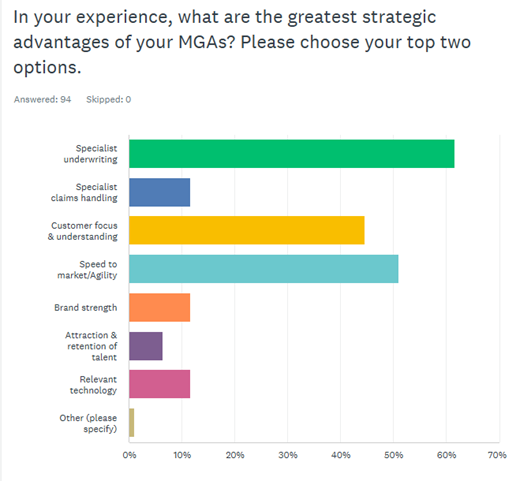
Figure shows: Author survey of 96 delegates at the 2026 MGAA Annual Conference
End-Customer Focus and Claims Specialism
Another universally quoted advantage of MGAs in my MGA leaders’ interviews, and supported by the Milliman MGA Survey, was MGAs’ understanding of customer and/or broker needs.
Insurance products need to reflect society’s needs, and in this they are varied and rapidly changing. MGAs are line-of-business specialists who understand the specific dynamics of a customer segment and therefore are in a strong position to understand relevant nuances and emerging opportunities/risks.
A carrier covering many lines of business is structurally less likely to have this kind of detailed customer knowledge in every line, but they can access it through intermediaries including MGAs. An MGA without detailed customer understanding does not provide a compelling partnership case for a carrier, so is unlikely to survive.
OneAdvent provides a useful recent case study for this type of niche expertise, launching Collective, an MGA providing tailored insurance products for photographers and musicians. Their co-founder was quoted, “Customers often rely on standard insurance that doesn’t reflect how these items are actually used”. 16
Another example comes from Anansi. When I interviewed their CEO Megan Bingham-Walker1, she explained how demand in the market let them to build last-mile shipping coverage for retailers “customers… not finding their solution.”
These echo a common raison-d’être for many MGAs: products that better match the unique needs of a specific demographic.
Mike Keating, CEO, MGAA, cited 1 that it’s also the access to specialist decision-makers that brokers value in MGAs. “MGAs can often find a way because they understand the customer and risk nuances, enabling them to be more agile and responsive.”
MGAs’ agility and innovation can result in products and technology that meet varied insurance needs. These end-customer benefits are also recognised by some regulators. At the recent MGAA Annual Conference, Andrew Ruddle from the UK’s Financial Conduct Authority highlighted areas including improving consumer understanding, claims and service quality, supporting innovation and increasing access to insurance and acknowledged MGAs’ role in these.
Agility, Technology and Data can give a Competitive Edge
The regulatory requirements on carriers necessarily oblige consideration of long-term impacts and wider impacts of risk. Add in the size and complexity of many carriers, and it becomes harder for decisions and tests to be quick. It therefore makes sense why many respondents cited access to MGA agility as an attractive reason for partnership. Relatively small, nimble, focused MGA teams can take quick advantage of commercial opportunities.
MGAs’ specialist focus can also be reflected in technology and data confidence. Technology is chosen to prioritise the nuances of their line of business, without competing priorities.
For example, the MGA ManyPets has built specialist claims technologies that are unique to the dynamics of Pet Insurance, enabling more efficiencies in a line of business that has traditionally been lower priority in composite insurers.
In addition, unpredictability can have different implications for larger insurance companies that need to consider stability of shareholder value. Predictability of earnings may have a higher priority, flowing into capital allocation and technology resourcing decisions. MGAs are an option to mitigate this potential structural disincentive to test and learn by offering lower barriers to entry.
Back-End vs Front-End Culture and Expertise.
Carriers and MGAs are structurally designed to do different things well. Carriers are responsible for the strength of the overall portfolio: capital management, regulatory compliance, risk oversight and long-term sustainability. That creates deep expertise and a culture of discipline, control and careful decision-making. It can also make product development slower, as new opportunities must be tested against governance requirements and wider portfolio considerations.
MGAs operate much closer to the market. With a narrower focus on specific products, customers or niches, they are typically more agile, more commercially driven and quicker to respond to change. Because they do not carry the same balance-sheet and regulatory burden as carriers, they can stay lean and concentrate on underwriting, distribution and product innovation.
These differences are not weaknesses; they are complementary strengths. Carriers bring back-end excellence in capital, governance and risk management. MGAs bring front-end strength in specialist expertise, customer proximity and speed of execution. In a well-structured partnership. This tension is productive, allowing each side to focus on where it adds the most value.
The actuarial perspective illustrates this clearly. A carrier may take a cautious view of a developing ultimate loss ratio, focusing on downside risk and reserve adequacy across multiple scenarios. An MGA is more likely to focus on the best estimate of the loss ratio being written today, so it can adjust pricing quickly and grow in profitable segments. Neither view is wrong. Together, they create a more balanced decision-making framework: one protects the balance sheet, while the other sharpens commercial responsiveness.
Looking closer at the Human side: Culture and Prioritisation
One of the toughest tasks of any business is prioritisation. A large carrier with multiple lines of business has many competing priorities, and the actions that have the greatest impact generally move to the front of the queue. It can be hard for niche or new lines to get bandwidth, especially if they compete with existing products. Accessing MGA lines of business enables a carrier to flexibly access different lines of business, entering or leaving lines of business without significant disruption
Innovation and new lines of business can also be a distraction from the key business of running major business lines. This was described by one leader from a carrier I spoke to as “the magpie effect” – where new “shiny things” attract outsized levels of attention from key employees. In this way, a small line could take the corporate eye off the ball from material everyday tasks. By separating a new line via an MGA, the carrier can ensure ongoing business focus on more material lines that ensure P&L success.
The MGA separation effect can be used to good effect even when sitting entirely within a carrier’s wider business model. Allianz UK has recently launched Slick Cover 13. Darya Dara is now leading its new MGA selling Car Insurance, entirely supported by Allianz, but ringfenced from existing Car insurance business, on different technology and with different objectives. When I interviewed Darya 1 about why Allianz would choose to start an MGA to innovate in this way, she pointed to key features such as a small, focused team concentrating on one future-focused product; rapid speed of new product creation; the ability to build on a new technology stack without disrupting other products, plus the ability to concentrate on different types of customer from the larger-scale Allianz products.
Ulf Lange, MD Personal Lines, Allianz UK adds in their press release “We’re excited by this move into the MGA space which demonstrates Allianz’s commitment to finding new and innovative ways to meet customers’ needs.” An MGA is one pathway to innovate without disturbing significant existing success in this space.
Passionate “Obsessives” and Specialized Talent Pools
When interviewing MGA leaders, two key talent features were recurring themes.
Firstly, what happens when your job and your passion are the same thing? It’s not for no reason that MGAs are often full of passionate hobbyists for the line of business they are in – whether that’s pet lovers in Pet insurance MGA ManyPets, or keen cyclists in bicycle MGA Laka. The talent specialist density in many MGAs means they understand customers because they are the very demographic they want to sell to. Furthermore, they love to be surrounded by others who do the same, to talk about the latest details and to push the boundaries of customer service.
This Employee Value Proposition – your passion is the priority for our business - can be an irresistible environment for the right specialists and structurally hard for a generalist carrier to replicate.
Mike Keating, CEO of the MGAA pointed to 1 how his members “love what they are doing” and how “enthusiasts have a direct correlation with expertise”
Similarly, deep specialists in a line are attracted to businesses that focus on making the line they love better, driving further talent density that becomes hard to replicate. The Instech report summarises this as MGA founders that are “insurance professionals that know the market and the clients’ needs very well, but have wanted to break free from their less agile employers.” 14
Secondly, an ongoing theme was of an entrepreneurial nature – talent that wants autonomy and control. Types of MGA business in this category included proven teams from traditional markets that want to build best-in-class specialist houses and innovators targeting emerging risks (such as AI-related products) or challenges with existing insurance markets.
Mike Brockman, serial insurance entrepreneur, argued 1 “the MGA environment is entrepreneurial with people willing to take calculated, expertise-based risks. The right culture enables measurable risk-taking, which drives reward.”
Talent Retention in a Competitive Landscape
The human factors of MGAs also benefit from one of the most important dynamics of an insurance business – attracting and retaining the best talent. Passionate businesses that enable specialists to stretch products and try what they know to be best for the customer will be the best environments for those specialists to stay in.
Challenges and Beautiful Relationships
The strength of the MGA ecosystem rests on the quality of the relationship between MGAs and carriers. This model works best when incentives, governance and expectations are clearly aligned. When they are, each party can focus on what it does best; when they are not, differences in culture and pace can quickly create friction.
For MGAs, alignment is essential. Without carrier capacity, there is no product to sell. That reality gives MGAs a strong incentive to build reputations for underwriting expertise, transparency and ease of doing business. The best MGAs become trusted partners, and increasingly find themselves able to choose the capital they work with rather than simply rely on it. As Mike Keating, CEO, MGAA, put it 1 , the market has shifted from “capital selecting MGAs” to “MGAs selecting capital.”
The most common point of tension is speed. MGAs are built to respond quickly to market opportunities, while carriers often move more cautiously due to governance, capital and portfolio responsibilities. Neither approach is wrong, but the difference must be actively managed.
The model is also evolving. MGA platforms such as OneAdvent helps underwriters launch and scale businesses more efficiently, while challenger carriers such as Bridgehaven and Wakam focus on regulatory, governance and capital excellence while partnering with MGAs to operate specialist lines. These developments show that the MGA-carrier model is becoming more sophisticated, with success increasingly driven by alignment, efficient capital deployment and complementary strengths.
AI Adoption in insurance: What does it mean for the future of MGAs?
The impact of Artificial Intelligence (AI) is already starting to be felt across insurance, and the MGA ecosystem will undoubtedly see the same magnitude of change.
A question I posed during my research is whether AI is likely to increase or decrease the importance of MGAs in the insurance value chain.
An argument for the reduction of MGAs is that carriers will be able to reduce admin, access better data and more rapidly innovate with the embedding of AI. Specialist knowledge will be easier to access, and all these things could erode the need for MGAs by carriers. In addition, many large carriers are investing heavily in AI with budgets MGAs cannot match, producing game-changing solutions and innovations in-house, such as Aviva’s underwriting tools for Life and Critical Illness cover. 12
When I put the argument that AI might erode MGA advantage to the experts in my interviews, the answers followed clear patterns: some MGAS are particularly well positioned to execute quickly on the advantages of AI in ways that will add further value to their business model to carriers.
Balancing Human Expertise with Technological Advancement will benefit all parts of the insurance industry, but the effects will be strongest for those with the best expertise and who can most rapidly and effectively embed the technology.
- AI can be a powerful enabler for Underwriters and Claims Teams. MGAs who boast teams of market-leading technical professionals are in a strong position to superpower these employees.
Tim Quayle, CEO, OneAdvent argued 1 that AI can be another tool for MGAs to differentiate and justify their value in the chain, and the more nimble MGAs have the opportunity to leverage AI faster than some large carriers.
- AI can supercharge predictive analytics, data ingestion, and process automation, again benefitting those organisations who best understand their data and how it can be interpreted. Many MGAs see their line of business specialist skills in these areas as a significant advantage.
Mike Brockman, CEO, ThingCo called out understanding of data as a possible MGA advantage 1 . “Some large players can collect poor-quality “unsmart” data, believing it’s a valuable asset.” Mike argued that MGAs are sometimes closer to the specialised data and may better understand its value
John Pyall, CUO of China Taiping pointed further to the importance of human connections in a world of AI 1 . He argued that he was expecting AI would make administration easier. However, it wouldn’t change expertise and networks needed to successfully understand and run a specialist line.
Deloitte estimates that by 2025, more than 25% of insurance companies will have entered into strategic partnerships or joint ventures to enhance technological capabilities 15. This strategic mindset only further underlines MGA opportunity to provide technical expertise by demonstrating AI skillsets.
In my opinion, in a world where AI is available to all as a tool, MGAs who can justify their position in the value chain can use these tools to further prove their worth to carriers in all the structural areas raised in this paper. MGAs who adopt fast and become more efficient should therefore see AI as a strong opportunity.
Furthermore, AI adds a whole new risk category to insurance as businesses across the world seek to protect themselves from unforeseen consequences of embedding AI into their processes. As expected, where there are innovative opportunities, there are already MGAs focused on products for these new risks, such as Testudo (liability coverage that protects businesses from the costs of lawsuits arising from the use of GenAI).
Whether or not MGAs capitalize on this opportunity to add value in an AI world will depend on the individual MGA and its strategy. At the recent MGAA Conference, the delegates surveyed demonstrated split sentiment about AI implications. There is a clear conclusion that the MGA market will be affected by AI, but not all companies have the same level of confidence about their own future journey.
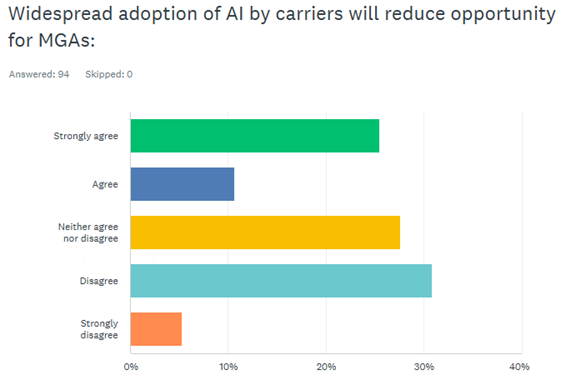
Figure shows: Author survey of 96 delegates at the 2026 MGAA Annual Conference
Future Outlook and Conclusion
MGAs are not an accident of the market. At their best, they are a robust partner to carriers: specialist, nimble and close to the customer, while carriers bring scale, capital and balance-sheet strength. When that relationship works, one plus one really can equal three.
MGAs exist because focus creates value. The best MGAs bring deep expertise, sharp underwriting insight and a real understanding of the customers and risks they serve. For carriers, that means faster access to specialist markets, better portfolio diversification and more efficient use of capital.
Their edge also comes from being built differently. Carriers must think about the long tail of risk and the demands of the wider balance sheet. MGAs can stay laser-focused on the needs of their niche markets today. That allows them to move faster, think more entrepreneurially and attract people with genuine specialist obsession.
Those strengths are becoming more, not less, relevant. In a market shaped by pressure on loss ratios, the need for strong governance and growing regulatory recognition of customer value, MGAs appear to have a clear role to play. And with AI opening new opportunities, MGAs may be better placed than many larger organisations to adopt technology quickly and turn it into commercial advantage. Customers demand more personalisation and specific relevance in their products, and MGAs are positioned to keep products, distribution and customer journeys attractive.
I conclude that MGAs are here today, and many will be here tomorrow — but not all.
The winners will be those that can prove they are worth their place in the value chain through specialist expertise and intelligent use of technology. Furthermore, in the age of AI, I believe that human edge may matter more than ever.
In that sense, the future is not necessarily bright for all MGAs as a category, but excellent MGAs will shine brighter than ever.
References and Direct Interviews
The views in this paper are those of Charlotte Halkett.
- With grateful thanks for direct Interviews with:
- Mike Keating, CEO, Managing General Agents’ Association
- Megan Bingham Walker, CEO, Anansi
- Tim Quayle, CEO, One Advent
- John Pyall, CUO, China Taiping UK
- Darya Dara, CEO, Slick Cover
- Mike Brockman, CEO, ThingCo
- Chubb Letter to Shareholders, Evan G Greenberg https://about.chubb.com/stories/2025-chubb-letter-to-shareholders.html
- MGAs in the UK https://uk.milliman.com/en-GB/insight/role-mgas-uk-insurance-market
- Howden Re’s view of Europe's MGA market https://www.howdenre.com/news-insights/howden-re-publishes-filtered-for-quality-a-refined-view-of-europes-mga-market
- https://insurance-edge.net/2025/04/02/capacity-and-the-mga-market-thriving-growing-and-innovating/
- Reinsurance Asia MGAs ‘gaining ground’ in China as nascent Asian market emerges – (Re)in Asia
- Guy Carpenter The evolving landscape of MGAs in Asia Pacific
- Asia Insurance Review The growing role of MGAs in Asia - Managing general agents
- Milliman Trends in UK Property & Casualty M&A https://www.milliman.com/en/Insurance/Mergers-and-acquisitions
- Datalab Webinar “The New rules of MGA Success” https://www.insurancedatalab.com/webinars/webinar-the-new-rules-of-mga-success-in-a-changing-market/
- Instech: MGAs and Actuaries in 2026 https://www.instech.co/knowledge-centre/mgas-and-actuaries-in-2026-the-state-of-the-market
- Aviva extends industry-first AI underwriting tool to Critical Illness cover - Aviva plc
- Allianz launches Slick Cover https://www.allianz.co.uk/news-and-insight/news/allianz-launches-slick-cover-car-insurance.html
- Instech, MGAs – so, have they been the fast track to innovation? https://www.instech.co/knowledge-centre/mgas-so-have-they-been-the-fast-track-to-innovation/
- Deloitte Insurance Outlook https://www.deloitte.com/us/en/insights/industry/financial-services/financial-services-industry-outlooks/insurance-industry-outlook.html
- Collective Press Release https://oneadvent.com/2026/06/25/oneadvent-launches-specialist-mga-collective-targeting-embedded-insurance-for-high-value-lifestyle-assets/