

A Tale of Two Retirements
Sam Chesterton, Vice President, Business Development, RGA UK
A phased approach to DC decumulation
Summary
Addressing the UK retirement landscape requires identifying its inevitable transition from defined benefit (DB) to defined contribution (DC) as the primary savings mechanism. This transition places the burden of sufficient pension savings and appropriate retirement decumulation firmly on the individual’s shoulders.
Retirement was a single transition point under DB, as lives moved to a predefined regular income similar to that of their working life. Retirement under DC needs to be reframed to two stages to aid retirees considering their appropriate method of decumulation, a decision now theirs to make. Stage 1’s “wining and dining” covers the initial phase of retirement, typically characterized by healthy life expectancy and the ability to enjoy more discretionary activities, like holidays. Stage 2’s “heating and eating” typically covers later retirement, with increased focus on core essentials, such as food and bills, through declining health or wealth.
A flex-then-fix model is recommended to match a decumulation product to each stage of retirement. “Flex” represents Stage 1: A drawdown solution is recommended, where the retirement pot remains invested and is spent at the retiree’s discretion. “Fix” represents Stage 2: A lifetime annuity is recommended, where a single payment to an insurer returns a regular income for life. Retirement collective defined contribution (R-CDC) is the incoming primary alternative to a lifetime annuity, also offering income for life. However, the uncertainty over the level of income provides a less suitable match to Stage 2’s more certain outgoings.
What is the optimal time to transition from flex to fix? Using the retirement living standard as a benchmark, individuals are encouraged to assess the premium required by an insurer to provide regular annuity income. Comparing this, alongside income from state pension (where eligible), additional mortgage or rental costs (where required), and income taxation, should provide a useful steer on the lowest annuity premium required. This, alongside monitoring cognitive capabilities, provides a regular reference point to help assess the right time to fix.
This paper addresses only the decumulation puzzle faced by retirees, not the even-more-important accumulation problem. Individuals saving insufficiently into their retirement pot is a key concern, with large numbers either not saving or under-saving. Improved support and product structures in retirement can enhance financial security for the masses, but providing a good outcome is made much harder by under-saving whilst working.
Reframing retirement
Retirement in the UK is a frightening concept for many. It is typically characterized by declining health and a reduced living standard.[1] It sees individuals suddenly needing to solo-navigate knowns (their finite retirement pot) and unknowns (their life expectancy and changing financial needs). Nobel Laureate William Sharpe dubbed the conversion needed under DC as “the nastiest, hardest problem in finance.”[2]
Historically in the UK, this retirement problem was one for companies, as the final-salary DB promises made to its beneficiaries guaranteed an income for life, smoothing their transition to retirement via a single transition point.
Figure 1: The proportion of working-age people with each private pension type within the household by cohort[3]
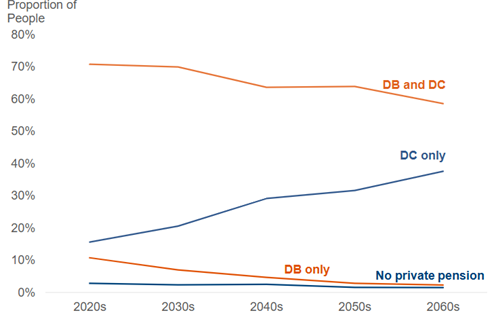
The UK is moving away from DB and toward DC. Under DC, the problem is one for the individual – who is both the decision-maker and the beneficiary. Indecision is a common and understandable reaction. This may be the biggest financial decision many people will make in their lifetimes.
This paper focuses on the UK’s DC population at the point of retirement. It aims to highlight the need for reframing the challenge presented to individuals and provide a supportive template for how best to navigate its uncertainties, all the way to death.
Two stages of retirement
Retirement under DB was appropriately framed as a single transition point, with lives moving from receiving a salary while working to (under this simplified example) the equivalent of a salary in retirement. This is no longer appropriate for most of the UK.
Under DC, the framing of retirement needs to be updated to educate the population on the new two-stage model.[4]
Stage 1: “Wining and dining”[5] indicates the ability for retirees to spend money on discretionary items, such as holidays and going out. These flexible outgoings are a “nice to have.” This stage is an option only for those with the required health and wealth.
Stage 2: “Heating and eating”[6] represents the need to focus sufficient expenditure on core essentials, such as food and bills. These perpetual outgoings are a “must have” for retirees to fund. This less-active stage of retirement is prompted by declining health or a smaller retirement pot. This ignores care-home costs.
People should determine at retirement how their retirement pot is best allocated to those two stages and when the transition from Stage 1 to Stage 2 likely will occur.
Navigating both stages
This paper’s recommended approach to decumulation considers products appropriate to the two identified stages of retirement. Matching those two life stages with their typical health indicators should aid understanding and retirement planning. We can then consider the available retirement products for each stage and when to transition between them. This provides a helpful structure for retirement planning. A key requirement is a system that also enables a flexible transition between the two stages, given the unique nature of every life’s underlying journey.
For a healthy life with a medium or large retirement pot, the route through these stages could include Stage 1 as well as Stage 2, with the transition occurring during the latter stage of retirement when prompted by health or wealth deterioration. An individual with a small pot at retirement could immediately proceed to Stage 2.
This paper focuses on the lives navigating both stages, who need an appropriate product combination to match that expenditure, alongside guidance on when to transition from Stage 1 to Stage 2. The key retirement products considered and discussed are drawdown, state pension, lifetime annuity, retirement collective defined contribution (R-CDC), and cash lump sum.
Evidence base
While health and mental capabilities will typically decline gradually during retirement, this is classified within the two distinct stages to enable a simpler framework for retirees to then consider the appropriate retirement products.
Two types of life expectancy
Looking purely through a health lens, the two stages of retirement align well with the two predominant definitions of life expectancy.
The Office for National Statistics (ONS) defines healthy life expectancy as measuring “health-related wellbeing and represents the average time an individual is expected to live in ‘very good’ or ‘good’ general health.”[7] This aligns with Stage 1. Later life expectancy (calculated as the overall life expectancy minus the healthy life expectancy) aligns with Stage 2, covering a period with reduced general health.
For England from 2022 to 2024, males/females who reached the typical retirement age of 65-69 years had a healthy life expectancy of 10.1/11.1 years and an overall life expectancy of 18.9/21.4 years. This suggests roughly 10.1/11.1 years are available for Stage 1. It also signifies the importance of the transition to end-state planning for Stage 2 across the remaining 8.8/10.3 years.[8]
Figure 2: Healthy life expectancy for ages 65-69 in England from 2012 to 2023 (please note, each data point represents an average over a three-year period, stated at its middle year)
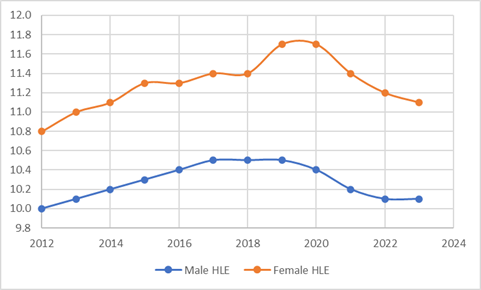
Comparing the 2019 and 2023 data points shows a larger decrease in healthy life expectancy (-0.4/-0.6 years), see chart, than overall life expectancy (-0.3/-0.2 years) for males/females, implying an increasing importance for Stage 2’s retirement planning.[9],[10],[11] Healthy life expectancy has suffered even more dramatic declines since 2012 when assessed at birth.[12]
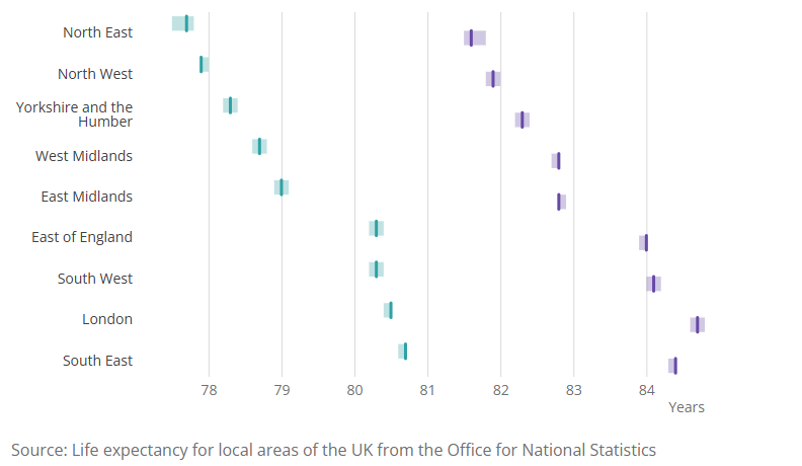
The impact of gender and geography, driven by socioeconomic status, on life expectancy was also notable, signifying the need for a flexible retirement system whose transition from Stage 1 to Stage 2 can be bespoken to the underlying life. Per the ONS, “the 10 local areas with the highest life expectancy at birth, for both males and females, were all in the south of England; the 10 local areas with the lowest life expectancy were concentrated in the north of England and in Scotland.”[13] Differences of up to three years were experienced across both genders, with more extreme results when comparing specific towns and cities.[14]
Figure 3: Life expectancy at birth by sex from 2022 to 2024 for the English regions (male in green, female in purple, with bars representing 95% confidence interval):[15]
Health and wealth self-assessment
Identifying whether a retiree is mentally and physically within their healthy life expectancy or later life expectancy is important to inform the appropriate product to match that stage of retirement.
Instrumental Activities of Daily Living[16] aims to define the qualities needed for living independently and includes “managing finances” as a required cognitive skill, a sensible reference for healthy retirement. This financial requirement is more subjective than the other activities listed, such as meal preparation or home maintenance.
The ability to independently fulfill these activities will likely deteriorate gradually and be more visible in hindsight, providing a challenge for lives to identify whether they are within the healthy or later life stage of retirement. Retirees need to conduct periodic check-ins to objectively assess their health status to inform their stage and therefore appropriate retirement product.
Behavioral bias
An RGA study[17] focusing on lifetime annuities found its primary benefit to retirees was that “Guaranteed income for life makes me feel secure.” However, the two key drawbacks were its ”irreversibility” and “lack of flexibility.” These competing sentiments are eased by now reframing retirement as two stages, as proposed, with the decumulation journey then needing to match this contradiction in desires and their expected evolution through retirement from wanting flexibility to needing security.
Decumulation product options
The UK government should advance the understanding of retirement products available to DC savers. Research carried out on behalf of the Department for Work and Pensions highlighted the varied understanding of decumulation products, with the ability to access the 25% tax-free lump sum of cash the only commonly understood option.[18] The long-term implications of drawdown and annuities were not well understood.[19] That most likely extends to R-CDC, given its recent introduction to the market. The key products considered here include:
- Drawdown – Income drawdown enables assets to remain invested, to be accessed and spent at the discretion of retirees.
- State pension – Individuals reaching the state pension age can receive an annuity-like stream of increasing income from the government proportional to their National Insurance contributions.
- Lifetime annuity – An upfront premium paid to an insurer returns income for life, either level or increasing, reflecting their underlying health.
- Retirement Collective Defined Contribution (R-CDC)[20] – Similarly providing income for life, but its premium is paid into an R-CDC fund, and the regular income can increase or decrease, depending on the fund’s performance.
- Cash lump sum – Typically, 25% of the retirement fund is available to access as cash without incurring tax, via a single transaction or across multiple.
Lifetime income
Lifetime (individual) annuities, R-CDC, and the state pension all provide regular income until death.
The state pension provides a maximum of £12,548 p.a., following sufficient National Insurance contributions,[21],[22] which rises annually to maintain buying power. This offers a base level of lifetime income that will likely remain available in the UK, although malleable under governmental policy, for those making sufficient National Insurance contributions.
Pension Freedoms in 2015 meant that DC pensioners no longer had to annuitize, opening the door to drawdown and cash lump sum access.[23] Before then, lifetime annuities had been the primary retirement product.[24]
A key alternative to lifetime annuities is now emerging in the UK for DC decumulation. R-CDC will operate similarly as a single premium paid at retirement and an income for life received. Its government consultation has closed, with its framework and authorization of schemes expected in 2029.[25],[26]
The income from R-CDC is anticipated to target at least Consumer Price Index growth,[27] but that is not guaranteed and can fluctuate depending on underlying fund performance. Because the income is not guaranteed, it can be invested into a greater proportion of growth-seeking assets, which aims to provide higher income.[28]
Lifetime annuities require detailed medical underwriting of the applicant to provide an income reflective of life expectancy. It is not yet clear what level of individual underwriting will occur for lives entering an R-CDC scheme.
Pension reform
This paper is being written while the pensions landscape is undergoing reform. The 2026 Pension Schemes Act will soon be implemented,[29],[30] and the Pensions Commission is renewing its assessment of the UK’s ecosystem.[31] Both are excellent signs that policy and law will start to catch up to the challenging pension reality faced by DC retirees.
Policies such as guided retirement are, like auto-enrolment, exceptional concepts that will make a meaningful improvement in the UK’s retirement market, if implemented correctly.
Guided retirement, whose implementation is now delayed until 2029,[32] will bridge the two periods of pension reform, with lives defaulted (when selected by the retiree) into a decumulation solution that provides a form of lifetime income. This requires schemes to offer a “default” decumulation route that individuals can select at retirement, thereby delegating responsibility to their pension scheme to place them on a generically appropriate product path.
Save first, spend later
Some statistics from the Pension Commission’s 2026 interim report[33],[34] were startling, concluding that Britain is under-saving for retirement and poorly managing decumulation. It highlighted that:
- 45% of wholly working-age adults are not saving into a pension at all
- Only 4% of wholly self-employed workers are saving for retirement
- Around half of low and middle earners are saving only the rate prescribed by auto-enrolment
- 30% of private pension pots are accessed as early as possible while 50% are taken out in full, and nearly half of those are spent on large expenses like a car or holiday.[35]
The key challenge not considered in the present discussion is the pension savings provision being made while working. Insufficient savings is the biggest problem faced by the UK’s retirement market, with the sustainable expenditure of those pension provisions a close second. This paper hopes to influence the latter, noting that the former is a key question for the ongoing Pensions Commission and future government. Insufficient accumulation provides insufficient decumulation.
Figure 4: The proportion of working-age people projected not to meet their TRR by private pension type and cohort reaching their state pension age (SPa):
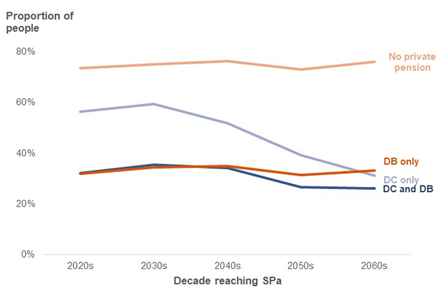
This chart uses Target Replacement Rate (TRR) as a measure of sufficient income in retirement, being calculated as a fixed percentage of pre-retirement earnings, with that percentage reducing as earnings increase. The key takeaway is the high percentage of DC-only lives who have under-saved/are under-saving for retirement. This is high over the coming decades but then declines, with a full career occurring since the introduction of auto-enrolment helping to reduce that level of under-saving.
Auto-enrolment was a UK workplace pension reform originating in the 2008 Pensions Act[36][37] that required employers to automatically enroll their employees into a pension scheme with minimum contributions of 8% in total across qualifying earnings. Auto-enrolment showed the power of defaults by vastly increasing the number of individuals saving for their retirement, but the contribution rate is insufficient by most pension metrics, and it does not address the self-employed part of the UK’s workforce. This policy was an excellent opening gambit, but further moves are required before we consider it a success.
Proposed solution
A decumulation solution should largely match the two stages of retirement. A perfect off-the-shelf answer for all lives is unrealistic, but a framework enabling customization is a feasible, responsible endeavor.
Flex-then-fix
Flex-then-fix is the appropriate model for engaged individuals retiring with DC pension pots expecting to proceed through Stage 1 and Stage 2. This is a single framework, comprised of two discrete components, with a continuous ability to structure their size and timing to meet the retirees’ bespoke needs. This does require an individual with a suitable understanding of their prospective outgoings and a sufficient retirement pot.
Flex refers to the flexible spending aims aligned with Stage 1’s active initial portion of retirement, during which the retirees are predominately capable of managing their finances akin to during working life. Fix applies to Stage 2’s more predictable expenditure and reflects the expected decline in physical and cognitive wellbeing, supporting a decision point to then delegate the future investment and longevity risk of their retirement. The combination of flexibility and certainty aims to align to the earlier stated desire for individuals to receive income guarantees without complete irreversibility.
The key question is when retirees should transition between the two constructs.
Flex: Drawdown is the appropriate flexible access product. Throughout working life, individuals are responsible for managing their finances, periodically budgeting to appropriately match their income to their outgoings. This stage of decumulation requires a similar approach but with the need to regularly check in on wealth and health to identify if needs, wishes, or health changes become more important. A key difference at this stage of retirement is the need to scale spending to their pension pot, rather than a salaried income (ignoring state pension).
Fix: The final leg in this journey requires a regular income paid until death, with a lifetime annuity best meeting this need. At the appropriate stage, an individual transitions to this product to ensure they have a consistent financial influx, ideally calibrated to meet their fundamental spending needs. The gain of certainty at the cost of flexibility makes sense at this stage, where individuals remain for the remainder of retirement. This is supported by any state pension income received.
As outlined, lifetime annuity and R-CDC, alongside the state pension where eligible, are the primary products offering lifetime income. As the requirement is to meet Stage 2-type bills, a guaranteed minimum income is needed to match those certain outgoings. Thus, annuity is a more suitable solution, compared to R-CDC, whose income-level uncertainty reduces the ability to confidently match income to spending.
That said, annuities require some sacrifices. Future health decrements will not be reflected after purchase, with those expected to increase in later life.[38] The premium paid for the annuity cannot be inherited by dependents upon death, unless certain guarantees are attached (for a cost). Flexible spending is also reduced, with the lump sum paid to the insurer received back via stable regular payments. These sacrifices are expected to be similar for R-CDC.[39]
Variations
Combining flex (drawdown) with fix (lifetime annuity) is intended as a suitable product set that can be easily tailored to many retirees’ personal circumstances. As outlined, there are variations to the flex-then-fix solution, namely:
- Flex-or-fix – For some lives with smaller pension pots, fully annuitizing immediately upon retirement may make sense, or similarly utilizing drawdown as the single method for decumulation may be more appropriate. This is bespoke to the life and can be influenced by many factors, such as other forms of income, severe illness, and bequest motives.
- Flex-and-fix – Where discretionary ownership of retirement’s decumulation journey is not desired by the retiree, then the use of “flex-and-fix” may be a more appropriate solution. This may be offered through the incoming guided retirement requirements.[40] The product offered by the scheme is to be determined in accordance with incoming regulation. This paper expects a flex-and-fix construct, similar to the flex-then-fix idea, as potentially being appropriate for the same reasons discussed. The core difference here is that the transition from flex to fix would likely be predetermined up front to remove the need for future discretion from the retiree, where desired.
“Then”
Under flex-then-fix, a retiree has ultimately opted to monitor their decumulation journey to then elect when to transition from flex (drawdown) to fix (annuity). The timing of that transition is unique for each life. Discussed here are some key considerations for a transition where there are sufficient cognitive capabilities to elect to purchase the annuity and the annuity purchased provides the required income level.
Retirees should ask themselves the following questions:
Is sufficient annuity income affordable?
Income-driven individual annuity quotes enable a person to calculate, based on their underlying health, the cost required by an insurer for a certain level of lifetime income. This can then be periodically monitored to see how the cost changes with their underlying health, age, and wider financial markets, providing a benchmark of the cost to de-risk their financial future through annuitization. That cost should be earmarked within the drawdown portfolio and converted to an annuity before that desired income becomes unaffordable. Poor investment performance of the drawdown portfolio would expedite this trigger.
A key question is what level of income should be targeted. To help estimate the needed annual income to death, Pensions UK’s “retirement living standards” estimate the annual costs of different buckets of lifestyle, classed as minimum/moderate/comfortable.
For a one-person household, these require £13,900/£32,700/£45,400 a year, respectively, and all assume the home is owned outright (i.e., no outstanding mortgage) and are post-tax requirements. It is noted that the minimum income here is higher than the current maximum state pension (£12,548 p.a.) and tax-free personal allowance in the UK (£12,570 p.a.). This highlights the need for additional provisions to meet those minimum regular outgoings beyond the state pension and to cover taxation, as well as the need to meet mortgage or rental costs if applicable.[41],[42]
Is the annuity rate optimized?
The 4% rule[43] is common within retirement finance to convert a retirement pot into an annual drawdown amount, with reasonable expectations that the pot will not be exhausted in less than 30 years at this rate and the retiree, thus, unlikely to outlive it. This assumes the amount withdrawn in year one, equal to 4% of the pot, is increased by inflation each year. While it is very simplistic and is not applicable to those retiring early (and some argue 5% is a more applicable factor), it is a rough benchmark retirees can consider.
Once the individual annuity rate comfortably exceeds the 4% benchmark, it is a signal to consider annuitization. The right time to annuitize is also impacted by age.
Assuming stable financial conditions and a consistent premium amount, the annual income offered from an annuity should increase each year its purchase is delayed. This is due to increasing mortality rates priced into the annuity, which signifies the decreasing life expectancy gap (i.e., life expectancy minus age), during which an insurer providing the annuity would be expecting to make payments. Taking an average age of 52 for the 50-54-year-old males’ group in England, the life expectancy in 2024 was 83.9 years old. For an average age of 87 for the 85-89-year-old equivalent, the life expectancy was 93.2 years. A 35-year increase in age sees an increase in life expectancy of only 9.3 years[44] and therefore an increasing level of income for each year the purchase is delayed. Health impairments are expected to be stable or to increase with age, further boosting the annuitization rate offered by delaying the annuity purchase through a lowered life expectancy.
Am I reducing my discretionary spending?
Increasing age is typically associated with decreases in activity, such as holidays, and therefore reduced discretionary spending. Later life’s outgoings can typically be more predictable and become increasingly appropriate for matching via an annuity. This stage similarly signifies an appropriate crossover point to annuitize.
While the 4% mechanism above references inflationary increases, the actual annuity purchase likely does not need this additional protection because consumption can decrease and the state pension already provides inflationary adjusted income, as applicable.
When to fix
Cognitive debits can occur during later life that could negatively impact the ability to make logical decisions, making cognitive decline a threat to an individual not annuitizing at the appropriate point.[45] This is hard to quantify at this stage; therefore, this paper recommends a crossover study to be conducted to better calibrate the appropriate age, or backstop age, to move from drawdown’s “flex” to the annuity’s “fix.” Considering the mortality credit, financial performance of savings and its impact on annuity rates, potential health and cognitive decline, and the impact of behavioral science is necessary to model the key influencers that determine how the industry can best support this perpetual question across retirement – when to switch the primary method of decumulation.
Conclusion
DC’s obligatory purchase of individual annuities before Pension Freedom was not ideal. While it provided a default and ensured a lifelong income, it was overly generic. Since then, the pensions industry has seen different challenges – greater choice but also the resulting indecision, and a system more likely to see private retirement savings running out before the end of life.
DC requires the UK to move away from DB’s historic single transition point, from working to retirement. Instead, a two-stage model is more applicable to today’s retirees. An appropriate retirement system is flex-then-fix, which matches the drawdown and lifetime annuity products to those two stages of healthy and later life retirement. A key question is the timing of the transition between the two products, which needs to be fully bespoke to the retiree’s personal circumstances.
The set of questions recommended to aid assessment of the appropriate time to transition is subjective, however, and personal health and financial markets are impossible to predict. In addition, the decline of cognitive capabilities and impact of socioeconomic grouping on mortality are both significant and likely unknown to retirees. Further investigation of these factors and a refined structure to aid retirees in identifying this crossover point is recommended.
This paper addresses individuals at retirement when faced with the important decision of their decumulation. Insufficient savings being available at retirement is probably the largest issue facing retirees, and a priority for future regulatory changes should be to increase pension contributions.
While this paper focuses on the UK’s landscape, DC is increasingly used globally for pension saving.[46],[47] William Sharpe’s comment – that this is the nastiest, hardest problem in finance – is not UK specific; it is, indeed, the toughest financial problem across the world.
References
AI was utilized only for high-level supportive tasks, namely reviewing the written paper against the discussion’s skeleton to identify areas for further development and to provide other high-level feedback.
[1] https://www.lboro.ac.uk/media-centre/press-releases/2026/may/retirement-living-standards-nation-not-saving/
[2] https://ritholtz.com/2017/06/thorniest-problem-finance/
[3] https://www.gov.uk/government/statistics/analysis-of-future-pension-incomes-2025/analysis-of-future-pension-incomes-2025
[4] https://www.pensions-expert.com/defined-contribution/the-future-of-dc-nest-unveils-retirement-blueprint/24592.article
[5] https://www.bigissue.com/news/social-justice/pensioner-poverty-heating-eating-bills-living-wage-foundation/
[6] https://www.bigissue.com/news/social-justice/pensioner-poverty-heating-eating-bills-living-wage-foundation/
[7] https://www.ons.gov.uk/peoplepopulationandcommunity/healthandsocialcare/healthandlifeexpectancies/bulletins/healthstatelifeexpectanciesuk/between2011to2013and2022to2024
[8] https://www.ons.gov.uk/peoplepopulationandcommunity/healthandsocialcare/healthandlifeexpectancies/bulletins/lifeexpectancyforlocalareasoftheuk/between2001to2003and2022to2024
[9] https://www.ons.gov.uk/peoplepopulationandcommunity/healthandsocialcare/healthandlifeexpectancies/bulletins/healthstatelifeexpectanciesuk/between2011to2013and2022to2024
[10] https://www.ons.gov.uk/peoplepopulationandcommunity/healthandsocialcare/healthandlifeexpectancies/bulletins/healthstatelifeexpectanciesuk/between2011to2013and2022to2024
[11] https://www.ons.gov.uk/peoplepopulationandcommunity/healthandsocialcare/healthandlifeexpectancies
[12] https://www.health.org.uk/reports-and-analysis/analysis/healthy-life-expectancy-trends-in-the-uk-a-watershed-moment
[13] https://www.ons.gov.uk/peoplepopulationandcommunity/healthandsocialcare/healthandlifeexpectancies/bulletins/lifeexpectancyforlocalareasoftheuk/latest
[14] https://www.health.org.uk/reports-and-analysis/analysis/interpreting-the-latest-life-expectancy-data
[15] https://www.ons.gov.uk/peoplepopulationandcommunity/healthandsocialcare/healthandlifeexpectancies/bulletins/lifeexpectancyforlocalareasoftheuk/latest
[16] https://www.ncbi.nlm.nih.gov/books/NBK470404/
[17] https://www.rgare.com/knowledge-center/article/from-complexity-to-confidence--applying-behavioral-science-to-annuity-decisions?queryID=175057d4b72288339252d04de0a6f13a
[18] https://www.pensionsage.com/pa/Clearer-support-needed-as-understanding-of-DC-decumulation-remains-limited.php
[19] https://www.gov.uk/government/publications/pension-decumulation-and-decision-making/pension-decumulation-and-decision-making-report
[20] https://www.gov.uk/government/consultations/retirement-collective-defined-contribution-pension-schemes/retirement-collective-defined-contribution-pension-schemes
[21] https://publications.parliament.uk/pa/cm5902/cmselect/cmworpen/76/report.html
[22] https://www.gov.uk/new-state-pension
[23] https://www.gov.uk/government/publications/pension-freedoms-and-dwp-benefits/pension-freedoms-and-dwp-benefits
[24] https://www.which.co.uk/news/article/6-things-weve-learned-from-10-years-of-pension-freedoms-ahv691w1xDgZ
[25] https://www.gov.uk/government/publications/workplace-pensions-an-updated-roadmap/workplace-pensions-an-updated-roadmap
[26] https://www.gov.uk/government/consultations/retirement-collective-defined-contribution-pension-schemes/retirement-collective-defined-contribution-pension-schemes
[27] https://www.gov.uk/government/consultations/retirement-collective-defined-contribution-pension-schemes/retirement-collective-defined-contribution-pension-schemes
[28] https://www.gov.uk/government/consultations/retirement-collective-defined-contribution-pension-schemes/retirement-collective-defined-contribution-pension-schemes
[29] https://www.legislation.gov.uk/ukpga/2026/22/contents
[30] https://www.thepensionsregulator.gov.uk/en/pension-schemes-act-2026
[31] https://www.gov.uk/government/collections/the-pensions-commission
[32] https://www.gov.uk/government/publications/guiding-principles-for-default-pensions/pension-schemes-act-2026-guided-retirement-guiding-principles
[33] https://www.gov.uk/government/publications/workplace-pensions-an-updated-roadmap/workplace-pensions-an-updated-roadmap
[34] https://www.gov.uk/government/news/britain-is-undersaving-for-retirement-warns-pensions-commission
[35] https://www.gov.uk/government/news/britain-is-undersaving-for-retirement-warns-pensions-commission
[36] https://www.moneyhelper.org.uk/en/pensions-and-retirement/pensions-basics/automatic-enrolment-an-introduction
[37] https://www.thepensionsregulator.gov.uk/en/business-advisers/automatic-enrolment-guide-for-business-advisers/minimum-contribution-increases-planned-by-law-phasing
[38] https://www.ii.co.uk/pensions/annuity/pros-and-cons-of-annuities
[39] https://www.gov.uk/government/consultations/retirement-collective-defined-contribution-pension-schemes/retirement-collective-defined-contribution-pension-schemes
[40] https://www.gov.uk/government/publications/guiding-principles-for-default-pensions/pension-schemes-act-2026-guided-retirement-guiding-principles
[41] https://www.retirementlivingstandards.org.uk/
[42] https://www.fidelity.co.uk/markets-insights/personal-finance/saving-for-retirement/the-4-percent-rule-the-basics/
[43] https://www.pensionbee.com/uk/pensions-explained/pension-withdrawal/what-is-the-4-per-cent-rule-for-withdrawals
[44] https://www.ons.gov.uk/peoplepopulationandcommunity/healthandsocialcare/healthandlifeexpectancies/datasets/lifeexpectancyforlocalareasoftheuksingleyearperiods
[45] https://www.ukbiobank.ac.uk/publications/brain-and-cognitive-ageing-the-present-and-some-predictions-about-the-future/
[46] https://www.mercer.com/insights/investments/market-outlook-and-trends/managing-retirement-with-global-dc-optimization/
[47] https://www.wtwco.com/en-gb/news/2026/02/global-pension-assets-rise-by-nearly-10-percent-reaching-new-high