
Leading Actuarial Teams through the AI Transition
Leonie Schlichthärle, Executive Director Actuarial, Gallagher Re
Navigating between Management Challenges and Efficiency Gains
Intro
The AI revolution has started. While there are many theories about how far it will evolve, and how far society will allow it to go, there is growing consensus that AI is no longer a future scenario but a present reality. Sometimes described as the “industrial revolution of knowledge work”, AI is beginning to affect highly skilled professions that previously seemed relatively protected from automation, including the actuarial profession.
For actuarial leaders, navigating this AI transition is becoming an increasingly important part of the role. Questions about the future of the actuarial profession, potential reductions in team sizes, and the demand for more AI use cases are increasing in both frequency and urgency. Because the target picture for AI in actuarial work remains uncertain, leading teams through this transition can feel like navigating with a map that constantly changes both the route and the destination.
This paper aims to illuminate parts of this map and evaluates the question of what management actions an actuarial leader should take to successfully lead an actuarial team through the AI transition. The biggest challenge for actuarial leaders is not AI adoption itself, but preserving and developing actuarial expertise in a profession where AI increasingly performs many traditional actuarial tasks. AI refers primarily to Generative AI technologies powered by Large Language Models (LLMs) that can augment or automate elements of actuarial knowledge work, including analysis, modelling, reporting, coding, and communication. The focus is on deriving actionable insights that can be implemented today, while recognizing that the ultimate end-state of how AI will reshape the insurance industry remains uncertain.
The paper is divided into two sections. The first section sets the scene by examining how AI is transforming the actuarial profession. Rather than focusing solely on a potentially distant future, it explores the changes that actuaries are already experiencing in their daily work. The second section focuses on the change management challenges faced by actuarial leaders as they navigate the AI transition.
Actuarial Work and AI
The central question: will actuaries be replaced? The first and most prominent question that arises when discussing actuarial work — and probably most jobs — in the context of AI is whether actuaries will be replaced by AI. There is no single answer to this question, and many responses are shaped by the perspective and potential bias of the group providing them.
Actuarial association view: hybrid AI-actuary workflows. Actuarial associations tend to describe the future actuary as a hybrid AI-actuary: not replaced by AI, but with AI heavily integrated into many workflows (Society of Actuaries, 2026). At the same time, they emphasize the importance of keeping human actuarial expertise and judgment in the loop, especially for actuarial decisions that affect human lives or involve ethical reasoning.
Occupational exposure evidence. A more systematic approach to this question is provided by the International Labour Organization in its ongoing study, ‘Generative AI and Jobs — A Refined Global Index of Occupational Exposure’ (Berg et al., 2025). Based on task allocations across occupational groups, the study places actuaries in the second-highest AI exposure group, with “above-moderate occupational exposure”.
The study recognizes the high variability of tasks within the actuarial profession, which makes full automation less likely. At the same time, it notes that more actuarial tasks may become suitable for AI over time. This is consistent with other evaluations, such as the AI Exposure analysis, which assigns actuarial jobs a high AI exposure rating of 88/100 but a more moderate replacement risk score of 32/100 (AI Exposure, n.d.).
Core takeaway: task mix matters. A common theme across these assessments is that replacement risk depends less on the actuarial profession as a whole and more on the specific tasks performed by an actuary. It will also depend on the willingness and ability of actuaries to adapt if larger parts of their current workload are taken over by AI.
More disruptive perspectives. It is also necessary to acknowledge more disruptive views on replacement risk. These are usually not limited to the actuarial profession, but argue that AI may fundamentally change the structure of companies and the way value is created, as discussed for example in Competing in the Age of AI (Iansiti & Lakhani, 2020). Such views raise wider questions about how much human workforce will still be required and how society should deal with the resulting social impacts.
While these more disruptive scenarios should not be dismissed, this paper follows a “human-in-the-loop” view (Mollick, 2024). Under this view, parts of what is currently understood as actuarial work will be taken over by AI, while other parts will remain with humans.
The Jagged Frontier
Which directly leads to the next question: How can this split between AI and human tasks be identified? This is not a trivial question. It already starts with the challenge of compiling a full list of actuarial tasks, as most actuarial roles have their own specific responsibilities. Therefore, this paper focuses less on defining a complete task catalogue and more on the general challenges involved in distinguishing between “just-me”, “me-and-AI”, and “only-AI” tasks (Mollick, 2024). At first glance, this may not seem like a completely new challenge. In the 21st century, actuarial work is already split between humans and computer systems. No one calculates statistical parameters by hand when suitable statistical software is available. The more relevant question is therefore: what makes collaboration with AI different from collaboration with established actuarial systems?
A familiar comparison: actuarial modelling platforms. A useful starting point is a familiar example, such as an actuarial modelling platform. These systems usually have a clearly defined scope. They produce outputs in a largely deterministic way, based on structured inputs and predefined modelling logic. They also tend to focus on specific parts of actuarial work. For example, one would not expect a modelling platform to write an executive summary for a board member.
Why AI is different. AI differs from these established systems in two important ways. First, there is often no fully transparent path explaining how it arrived at a result. This creates two challenges: results may be wrong, and they may not be reproducible. Both aspects run counter to core actuarial principles. Second, AI can span multiple areas within one application. It is already possible to upload unstructured data and ask an AI system to perform an end-to-end actuarial analysis, including a polished executive presentation. This breadth of capability is fundamentally different from the narrower scope of traditional actuarial systems.
The jagged frontier between actuarial and AI tasks. Taken together, these aspects mean that there is no simple or stable task split between actuaries and AI. Instead, the boundary is better described as a “jagged frontier” (Dell’Acqua et al., 2023; Mollick, 2024). This frontier cuts across several areas of actuarial work and has two features that are particularly important for managing AI transformation in actuarial teams (see illustration 1).
Feature 1: The boundary is not intuitive. The frontier is jagged because it does not follow the familiar logic of traditional actuarial systems. Expectations about system performance have been shaped by tools that work in more predictable and clearly defined ways. AI may perform very well on one task, but deliver poor results on another task that appears very similar. One example is the difference between coding models, where AI may perform strongly, and calculating model results, where performance may be more mixed.
As a result, there is no easy line to draw between tasks where AI should be used and tasks where it should not. Actuarial teams will need to rely on structured trial-and-error experiments to test where the frontier currently lies. This differs from traditional software, where the boundary of what the system can and cannot do is usually much more clearly defined.
Feature 2: The frontier is a moving target. The second important feature is that the jagged frontier is not fixed. One useful guiding principle is: “Assume the AI you are currently using is the worst one you will ever use” (Mollick, 2024). AI systems have developed rapidly in recent years, and there is no certainty about where this development will stop.
Consequently, evaluating AI capabilities cannot be a one-off exercise. It will need to become an ongoing management task. Designing efficient workflows around this continuous evaluation will be one of the core challenges in realizing the potential efficiency gains from AI.
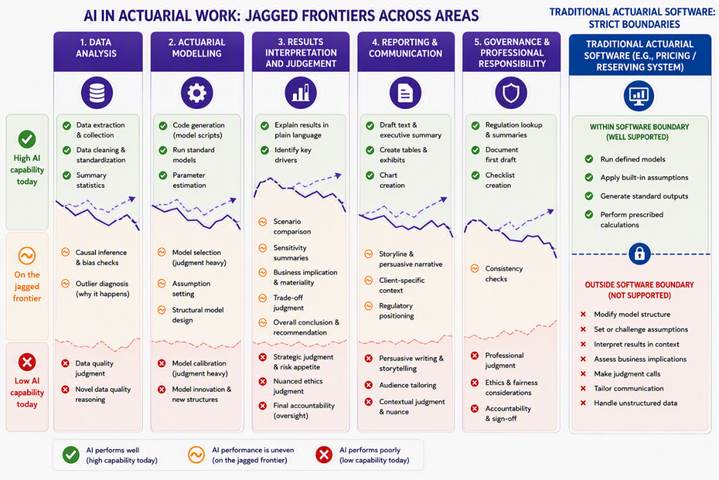
Illustration 1: The jagged frontier for AI and actuarial work based on Mollick (2024) AI generated
If AI capability is characterized by a moving and uneven frontier, the primary challenge becomes no longer technological but managerial. Actuarial leaders must decide how teams should adapt while the boundary between human and AI-supported work continues to evolve.
Leading through the Change
Why the AI transition is Different
From technical disruption to leadership challenges. Discussions about the AI transition tend to focus heavily on technical aspects and the replaceability of certain tasks. However, as with any major change, the human aspect should not be neglected. These technical disruptions are not happening in theory; they are being faced by established actuarial teams and managers who need to navigate the transition in practice. As outlined in the previous chapter, the introduction of AI is unique because it introduces a technical co-intelligence that works differently from the established actuarial systems we are used to. At the same time, it has the potential to disrupt processes and workflows more comprehensively than most previous change processes, perhaps only comparable to the introduction of computers into office work.
A moving-target environment. Perhaps the biggest challenge in managing a team through this change is that there is no clear target picture. Unlike previous actuarial transformations, such as Solvency II or IFRS 17, the AI transition does not have a clearly defined end state. Organizations are operating in a moving-target environment in which technology, workflows, and required skills evolve continuously.
Implication for actuarial leadership. As shown in Illustration 2, actuarial leaders are not managing a transformation towards a fixed end-state, but a continuously evolving target. Consequently, the primary leadership challenge is not managing a one-time transformation, but building adaptive actuarial teams that can continuously learn, experiment, and evolve while preserving the professional judgment on which the actuarial function depends. This makes the AI transition a change management challenge that most actuarial leaders have not yet faced during their careers.
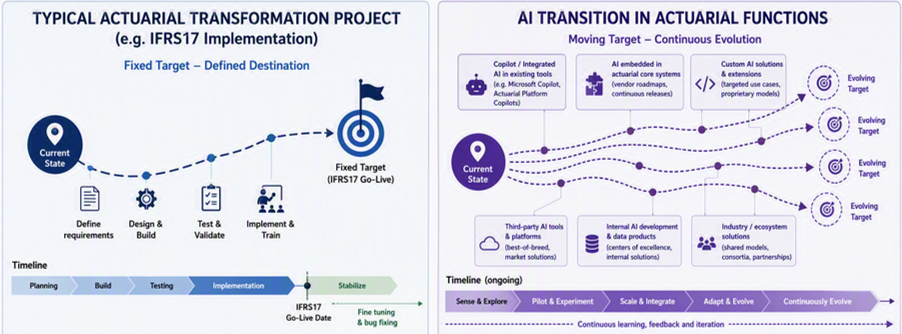
Illustration 2: Comparison between traditional and AI transformation
AI generated
To navigate the AI transition there are four core areas actuarial leaders have to consider and develop fitting actions:
- Building Awareness and Acceptance
- Redefining Roles and Team Structures
- Developing Future Expertise
- Demonstrating Value
1. Building Awareness and Acceptance
One of the most foundational challenges before any successful change management can start is to create awareness of the changing AI environment and that working with AI will become the new way of working.
Building awareness in a moving-target environment. Actuaries need to recognize that the actuarial role will change due to AI, even though the full extent of the change is not yet known. This makes the transition difficult to communicate: leaders need to bring everyone on the journey while acknowledging that the target picture will continue to evolve. At the same time, core actuarial principles remain unchanged. AI-generated results still need to meet actuarial quality criteria, require professional challenge, and cannot be accepted with blind trust. This “not everything changes” message can help reduce resistance and create a more balanced discussion about the role of AI.
- Efficiency potential. If managed well, AI can release experienced actuaries from parts of repetitive technical production and allow them to focus more on judgment, review, interpretation, stakeholder communication, and the design of better actuarial workflows.
- Management actions. Leaders should communicate clearly that AI use will become part of the future actuarial standard, define the non-negotiable principles of actuarial responsibility, and create safe opportunities for experimentation. Team members who actively avoid or boycott AI should be engaged early to understand the reasons for resistance, but expectations around minimum AI literacy and participation should also be made explicit.
Managing skepticism without losing efficiency. Experienced actuaries may be skeptical of AI-generated output and reproduce results using traditional actuarial methods. This is necessary during the initial trial-and-error phase, but if continued indefinitely it removes much of the efficiency benefit of AI. The challenge is therefore to find a balanced human-in-the-loop approach: AI outputs must be challenged, but not every result should be fully recreated from scratch.
- Efficiency potential. Clear review standards can unlock efficiency gains by reducing duplicate work. AI can be used where it improves speed or quality, while actuarial effort is concentrated on areas that require professional judgment, materiality assessment, model challenge, and communication of uncertainty.
- Management actions. Teams should define review principles for AI-assisted work, share examples of successful and unsuccessful AI use, and regularly update the task split between actuary and AI along the jagged frontier. This avoids duplicated work and helps the team learn where AI can be trusted, where it needs challenge, and where traditional actuarial approaches remain necessary.
Avoiding hidden or fragmented AI use. The potential of AI is greatest when employees at all levels and across functions trial it openly. Employees know their own work best and are therefore well placed to identify where AI can make it more efficient. If AI use is hidden, inconsistent, or treated as an individual shortcut, the organization loses the opportunity to learn systematically from these experiments.
- Efficiency potential. Open AI use can generate bottom-up productivity improvements, reduce work people do not enjoy, and create more time for higher-value actuarial activities such as interpretation, client advice, and judgment-based review.
- Management actions. Management should clearly communicate that responsible AI use is encouraged and will become part of the future way of working. This should be supported by incentives for sharing use cases, team-level learning sessions, and a positive narrative that AI is intended to reduce low-value work and increase the time available for work actuaries find meaningful. At the same time, leaders should address employment concerns transparently, as fear of replacement may otherwise drive AI use underground.
Integrate AI-nativeness of junior actuaries. Younger actuaries are often more open to experimenting with AI, as during a larger part of their education AI was already available as a tool. They also profit from a shift in actuarial and university education towards AI methods and applications. Nevertheless, they have to learn the way of working with AI within a professional environment.
2. Redefining Roles and Team Structures
Once the foundational awareness is built, actuarial leaders have to determine how roles and career paths will be changed in an AI-enabled environment.
Disruption in performance rankings. AI may allow less experienced colleagues to reach certain technical skill levels much faster than before, particularly in areas such as coding. This can challenge the professional self-understanding of experienced team members whose expertise took many years to build. In a results-oriented environment, it will increasingly matter less whether an output was produced with or without AI, especially if the AI-enabled version is more efficient and of comparable quality.
- Efficiency potential. This disruption also creates a significant opportunity. If AI helps raise the baseline performance of the whole team, experienced actuaries can shift from being individual technical producers to becoming enablers of higher-quality team output. For example, colleagues with strong coding expertise are well placed to train others in creating better prompts, reviewing AI-generated code, and setting up agentic workflows that make coding-related tasks more efficient for everyone.
- Management actions. Managers should explicitly recognize the value of experienced actuaries in AI-enabled workflows, not only as producers of output but as quality setters, reviewers, trainers, and workflow designers. Performance discussions should reward effective use of AI, knowledge sharing, judgment, and the ability to improve team-level productivity, rather than only traditional individual technical execution.
Do we still need junior actuaries? This question appears straightforward at first. If experienced actuaries remain essential as the “human-in-the-loop”, actuarial teams still need to hire and develop juniors to create the next generation of senior actuaries. However, the more difficult question is whether fewer juniors will be needed if AI enables them to become productive more quickly from the start. This issue is likely to attract increasing management attention, particularly in the context of potential cost-saving initiatives.
- Efficiency potential. AI may produce results faster than junior actuaries in many areas, particularly for entry-level tasks like data cleaning and basic statistical analysis. Agent-based workflows could also allow multiple subtasks to be handled simultaneously, reducing the need for manual junior-level production work. At the same time, AI may shorten training periods by helping juniors produce initial outputs more quickly and learn from immediate examples.
- Management actions. Leaders should review the tasks currently performed mainly by juniors and assess which of them can be supported or taken over by AI. They should then make deliberate decisions about which tasks juniors still need to perform themselves in order to build actuarial expertise. This should be done selectively to support learning, rather than as a general rule that all traditional junior tasks must be preserved. Future hiring cases should therefore focus on developing expertise in areas that remain outside, or close to the edge of, the jagged frontier.
Role and responsibility implications. The specific redefinition of roles and responsibilities will depend heavily on how AI is used within each department. As the AI target model continues to evolve, actuarial leaders may need to review roles and task allocations regularly rather than treating them as fixed. They should also address team members’ uncertainties about the future relevance of their roles in a transparent way. Based on the current understanding, the main takeaway is that AI can help junior actuaries become productive more quickly, while experienced actuaries increasingly shift towards review, judgment, workflow design, and team enablement.
3. Developing Future Expertise
One of the most important leadership challenges is ensuring that actuarial expertise continues to develop when AI increasingly performs tasks that historically served as learning opportunities.
How can actuarial expertise be built in an AI-enabled way? The core issue is the apprenticeship problem. Many of the tasks that experienced actuaries previously used to build actuarial expertise and judgment can now be performed more efficiently by AI. At the same time, AI creates an obvious shortcut to producing results, which disrupts established learning models not only in actuarial teams, but also in education more broadly (OECD, 2026). The main challenge is therefore to design on-the-job actuarial training that embraces the potential of AI while still enabling juniors to think independently and build their own actuarial judgment.
Using AI to Accelerate Learning. AI can offer a major advantage in training junior actuaries through the concept of an AI coach (Mollick, 2024). Direct one-to-one coaching has proven to outperform many other forms of education (e.g. as described in Bloom’s famous 2 Sigma study from 1984), but in actuarial teams this coaching time is usually limited by the availability of senior actuaries. An AI coach can help fill this gap by giving juniors more frequent feedback, challenging their results, and accelerating their learning journey. It does not need to replace human coaching; rather, it can complement it while also teaching juniors how to interact critically with AI-generated outputs.
- Management actions. Leaders should redefine on-the-job training for an AI-enabled environment. This means using AI to create efficiency gains where appropriate, rather than preserving traditional junior task allocation simply because it was established in the past. At the same time, current research suggests that some forms of non-AI-supported-learning remain necessary to build the expertise required later in an actuarial career (OECD, 2026). One practical approach is to let juniors perform actuarial analyses themselves while also running comparable AI-supported analyses in parallel. Comparing the results afterwards helps juniors continue learning from doing the work themselves, while also developing the increasingly important skill of judging AI-created outputs and understanding the jagged frontier through their own experience.
4. Demonstrating Value
The measurement challenge. The preceding sections show that AI transformation creates both leadership challenges and potential efficiency gains for actuarial teams. The need to address these issues will not only arise from within the actuarial function; it is also becoming an increasing priority for top management. Ultimately, AI initiatives will only continue to receive investment if actuarial leaders can demonstrate measurable value creation. Actuarial leaders should therefore expect to be challenged on their AI initiatives and on their contribution to company-level target KPIs.
This raises a central management question: how can the impact of the AI transition be measured? So far, many AI success stories appear episodic, which is understandable during a trial-and-error phase. As the transition progresses, however, impact will need to become more measurable in order to support continued investment in AI technology and meet stakeholder expectations regarding value creation.
When measuring the impact of AI initiatives, KPIs can be separated into two perspectives (Deloitte Insights, 2024):
- Internal perspective: Track AI adoption, workflow efficiency, and process improvements within the actuarial function.
- External perspective: Link AI initiatives to core financial and insurance KPIs to demonstrate whether internal efficiency gains translate into measurable company impact.
For both perspectives, multiple KPIs can be derived to help actuarial leaders provide evidence of the impact of their AI initiatives (see illustration 3). For the external perspective, however, one important limitation must be recognized: the effect of AI can be difficult to isolate from other drivers of insurance performance. Technical results are inherently volatile, especially in the short term. Careful trend monitoring, transparent assumptions, and realistic expectation management are therefore essential.
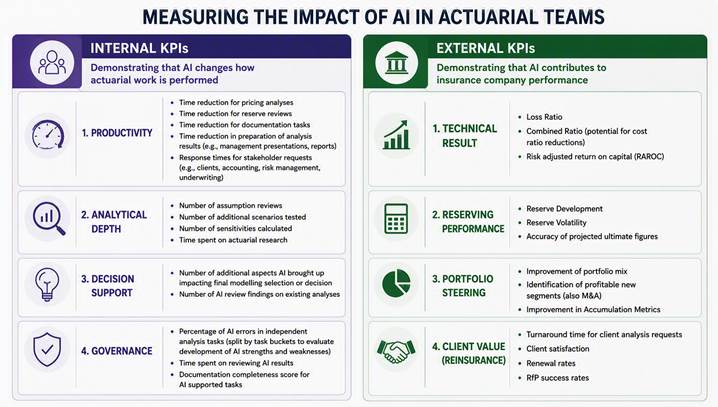
Illustration 3: KPI Matrix
AI generated
Conclusion
This paper has examined how actuarial leaders can guide their teams through the ongoing AI transition. It explored where AI may enter actuarial work, why this transition differs from previous actuarial transformations, and which leadership challenges arise when building AI-literate teams. The central management task is to translate the potential of AI into measurable gains for insurance companies while preserving actuarial judgment, quality, and accountability.
Looking at AI transformation in the financial and insurance sector more broadly, the disruption may extend beyond integrating AI into existing workflows and realizing efficiency gains. Some studies suggest that the largest value for companies may arise from deeper business-model transformations and the emergence of new profit pools (McKinsey & Company, 2026). A useful analogy is the introduction of electricity in the nineteenth century: the real transformation did not come from simply replacing steam engines with electric motors, but from redesigning entire production systems around the new technology. For insurance companies, it remains unclear what an equivalent transformation will ultimately look like, as technological capabilities and market expectations continue to evolve rapidly.
One area where early signs of disruption are already visible is insurance distribution. If AI helps customers understand, compare, and manage increasingly complex insurance products, traditional distribution channels may change. Recent market reactions to AI-enabled insurance distribution demonstrate that investors already see this possibility as material (Investing.com, 2026). While this example is not actuarial in nature, it highlights a broader point: changes elsewhere in the insurance value chain will ultimately affect actuarial work through their impact on product design, pricing, risk selection, and portfolio management.
For actuarial leaders, this means managing two challenges simultaneously. The first is the visible challenge of integrating AI into actuarial workflows and realizing efficiency gains. The second is preparing teams for a future that remains uncertain, where the boundary between actuarial and AI-supported work continues to evolve along a jagged frontier.
Ultimately, the success of the AI transition should not be measured by the amount of work automated, but by the extent to which actuarial expertise is strengthened. The greatest risk may not be that AI replaces actuarial work, but that it replaces some of the experiences through which actuarial judgment has traditionally been developed. The actuarial leaders who will be most successful in the AI era will therefore not necessarily be those who adopt AI first, but those who most effectively combine AI-enabled productivity with the continued development of actuarial expertise, professional judgment, and organizational trust.
AI Usage Disclosure
AI tools were used to support research, source identification, translation, English language refinement, and the creation of illustrations included in this paper. All AI-generated suggestions were reviewed, edited, and validated by the author. The ideas, analysis, conclusions, and final written content are the author's own work.
References
Books and Publications
- Berg, J., Gmyrek, P., Kamiński, K., Konopczyński, F., Ładna, A., Nafradi, B., Rosłaniec, K. & Troszyński, M. (2025). Generative AI and Jobs: A Refined Global Index of Occupational Exposure. ILO Working Paper No. 140. Geneva: International Labour Office.
- Bloom, B.S. (1984). The 2 Sigma Problem: The Search for Methods of Group Instruction as Effective as One-to-One Tutoring. Educational Researcher, 13(6), 4-16. American Educational Research Association.
- Dell’Acqua, F., McFowland III, E., Mollick, E., Lifshitz-Assaf, H., Kellogg, K., Rajendran, S., Krayer, L., Candelon, F. & Lakhani, K. (2023). Navigating the Jagged Technological Frontier: Field Experimental Evidence of the Effects of AI on Knowledge Worker Productivity and Quality. Harvard Business School Working Paper.
- Marco Iansiti & Karim R. Lakhani (2020). Competing in the Age of AI: Strategy and Leadership When Algorithms and Networks Run the World. Boston: Harvard Business Review Press.
- Mollick, E. (2024). Co-Intelligence: Living and Working with AI. Portfolio / Penguin Random House.
- OECD (2026). OECD Digital Education Outlook 2026. Organisation for Economic Co-operation and Development (OECD).
- Society of Actuaries (2026). The Actuarial Mindset in the Age of Artificial Intelligence. Society of Actuaries Research Report.
Web Sources
- AI Exposure. Will AI Replace Actuaries? Risk Score: 32/100. AI Exposure. Accessed 13 August 2026.
https://www.aiexposure.com - Deloitte Insights (2024). Measuring AI Investment KPIs: While Business Leaders Look Inward for AI’s Impact, Tech Leaders Look Outward. Deloitte Insights, 26 September 2024. Accessed 13 August 2026.
- Investing.com (2026). Insurance Broker Stocks Tumble as OpenAI Approves First AI Insurance App. Investing.com. Accessed 13 August 2026.
https://www.investing.com - McKinsey & Company (2026). AI Productivity Gains and the Performance Paradox. McKinsey & Company. Accessed 13 August 2026.
https://www.mckinsey.com - World Economic Forum. Organizational Transformation in the Age of AI: How Organizations Maximize AI's Potential. World Economic Forum. Accessed 13 August 2026.
https://www.weforum.org/publications/organizational-transformation-in-the-age-of-ai-how-organizations-maximize-ais-potential/